Turbochargers Explained: How They Work, Types, Benefits, Problems & Signs of Failure
Learn how turbochargers work, the different types of turbochargers, their benefits and drawbacks, what causes turbo failure, common warning signs, and how to keep your turbocharger performing at its best.
Post by: Sawiva | 2025-08-06 12:09:42
Turbochargers: The Little Machine That Makes Your Engine Breathe Harder
Ever wondered how a relatively small engine can produce the power of a much larger one?
Meet the turbocharger.
A turbocharger is one of the cleverest pieces of engineering hiding under your car's bonnet. It takes energy that would otherwise escape through the exhaust and uses it to force more air into the engine.
More air means more oxygen.
More oxygen means the engine can burn more fuel.
And more fuel and oxygen, when properly controlled, mean more power.
Basically, a turbocharger looks at your engine and says:
"You know what? I think you can do better."
But turbochargers aren't simply power boosters. They also play an important role in improving engine efficiency, reducing emissions and allowing manufacturers to produce smaller engines without sacrificing performance.
So, how exactly does a turbocharger work?
What Is a Turbocharger?
A turbocharger, commonly called a turbo, is a forced-induction device that uses exhaust gases from an engine to compress the air entering the engine.
A conventional naturally aspirated engine relies largely on atmospheric pressure to push air into the cylinders.
A turbocharged engine doesn't wait for the atmosphere to do all the work.
The turbo compresses the incoming air, allowing more oxygen to enter the combustion chamber.
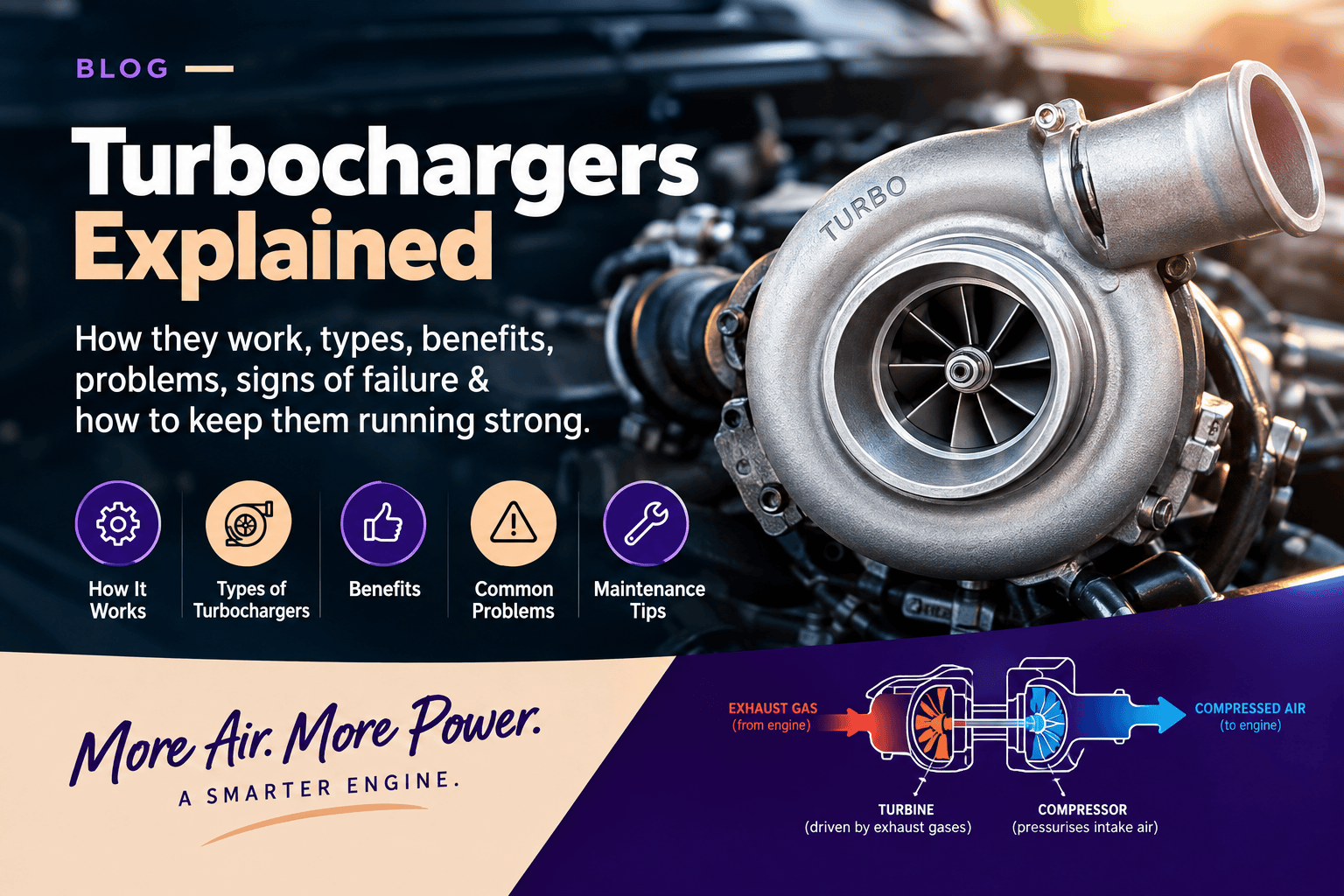
The basic turbocharger consists of two main sections:
-
Turbine
-
Compressor
These are connected by a common shaft.
The exhaust gases coming out of the engine spin the turbine. The turbine spins the shaft, which turns the compressor.
The compressor then draws in fresh air, compresses it and sends it toward the engine.
It's essentially an exhaust-powered air pump.
How Does a Turbocharger Work?
The process can be broken down into a few simple steps.
1. The engine produces exhaust gases
During combustion, the engine produces exhaust gases.
In a naturally aspirated engine, those gases travel through the exhaust system and eventually leave the vehicle.
With a turbocharger, some of that energy gets put to work.
2. Exhaust gases spin the turbine
The exhaust gases are directed toward the turbocharger's turbine wheel.
The gases cause the turbine to spin at extremely high speeds.
Depending on the turbocharger and operating conditions, the turbine can spin at well over 100,000 revolutions per minute.
That's faster than your engine will ever spin.
3. The turbine spins the compressor
The turbine is connected to the compressor wheel through a shaft.
Therefore:
Exhaust gas → Turbine → Shaft → Compressor
As the turbine spins, the compressor spins with it.
4. The compressor compresses incoming air
The compressor draws air from the air intake system and compresses it.
Compressed air contains more oxygen molecules in the same volume of air.
This allows the engine to receive significantly more oxygen than it could naturally draw in.
5. More oxygen allows more fuel to be burned
The engine management system adjusts fuel delivery to match the additional air.
The result is a more powerful combustion event.
And that's where your extra horsepower comes from.
The Main Parts of a Turbocharger
A turbocharger may look like one complicated component, but it consists of several important parts.
1. Turbine Wheel
The turbine wheel is driven by exhaust gases.
It converts the energy in the exhaust gas into rotational energy.
2. Compressor Wheel
The compressor wheel draws in and compresses fresh air before sending it into the engine.
This is the side responsible for increasing intake pressure.
3. Center Housing
The center housing connects the turbine and compressor sections.
It contains the turbocharger's shaft, bearings and lubrication passages.
4. Turbocharger Shaft
The shaft connects the turbine wheel to the compressor wheel.
When the exhaust spins the turbine, the shaft transfers that rotation to the compressor.
5. Bearings
Turbocharger bearings allow the shaft to rotate at extremely high speeds while minimizing friction.
Depending on the turbocharger design, these may include journal bearings or ball bearings.
6. Wastegate
The wastegate controls how much exhaust gas reaches the turbine.
When boost pressure reaches the desired level, the wastegate can divert some exhaust gas around the turbine.
This prevents excessive boost.
7. Blow-Off Valve / Diverter Valve
These valves help manage pressure on the compressor side, particularly when the throttle closes.
You'll hear enthusiasts talk about them when discussing that familiar "psshh" sound.
The noise may be entertaining, but the valve's primary job is pressure management—not soundtrack production.
8. Intercooler
Technically, the intercooler isn't part of the turbocharger itself, but it is an important part of many turbocharged systems.
Compressing air makes it hotter.
The intercooler cools that compressed air before it enters the engine.
Cooler air is denser, meaning more oxygen can enter the cylinders.
What Are the Different Types of Turbochargers?
Not all turbochargers are designed the same way.
Manufacturers use different turbo configurations depending on the engine's size, intended performance and operating characteristics.
1. Single Turbocharger
The simplest setup uses one turbocharger.


This is the most common configuration.
Advantages
-
Simple design
-
Lower cost
-
Easier maintenance
-
Good balance between performance and efficiency
Disadvantages
A single turbo may have to compromise between low-RPM responsiveness and high-RPM power.
A large turbo can produce excellent power at high RPM but may take longer to build boost.
A small turbo responds quickly but may struggle to provide enough airflow at high engine speeds.
2. Twin Turbo
A twin-turbo system uses two turbochargers.

There are several ways to configure them.
Parallel Twin Turbo
Each turbocharger supplies air to a portion of the engine.
This arrangement is commonly used on V6 and V8 engines, where each turbo can serve one bank of cylinders.
Sequential Twin Turbo
One turbo operates primarily at lower engine speeds while the second turbo comes into operation as engine speed and airflow increase.
The goal is to combine:
Quick response + strong high-RPM performance
Advantages
-
Better power delivery
-
Potentially reduced turbo lag
-
Greater airflow capacity
-
Excellent performance potential
Disadvantages
-
More expensive
-
More complicated
-
More components to maintain
-
More potential failure points
Two turbos can mean twice the fun.
They can also mean twice the number of components your mechanic has to investigate when something goes wrong.
3. Twin-Scroll Turbocharger
A twin-scroll turbocharger uses two separate exhaust passages feeding the turbine.

Instead of allowing exhaust pulses from different cylinders to interfere with each other, the system separates them.
This helps the turbo use exhaust energy more efficiently.
Benefits
-
Faster spool-up
-
Improved low-RPM torque
-
Better throttle response
-
Improved efficiency
-
Strong overall performance
Twin-scroll turbochargers have become increasingly popular because they can offer a good compromise between responsiveness and high-end performance.
4. Variable Geometry Turbocharger (VGT)
A variable geometry turbocharger, also known as a variable nozzle turbocharger, uses adjustable vanes around the turbine.


The vanes change position depending on engine speed and operating conditions.
At lower engine speeds, the vanes can help direct exhaust gases more aggressively toward the turbine.
At higher speeds, they can open to allow greater exhaust flow.
Benefits
-
Excellent low-speed response
-
Strong torque
-
Improved efficiency
-
Broad operating range
Drawbacks
-
More complicated
-
More expensive
-
Vanes can become stuck because of carbon buildup
-
Repairs can be more expensive
VGTs are particularly common in diesel engines.
5. Electric Turbochargers
Modern vehicles are also beginning to use electrically assisted turbochargers.
Instead of relying entirely on exhaust gases to accelerate the compressor, an electric motor can help the turbo spool up.
This can significantly reduce turbo lag.
Some systems combine conventional exhaust-driven turbocharging with electrical assistance.
Benefits
-
Extremely fast response
-
Reduced turbo lag
-
Improved low-speed torque
-
Better efficiency
Drawbacks
-
Greater complexity
-
Higher cost
-
More demanding electrical systems
Why Do Cars Use Turbochargers?
Turbochargers aren't just about making cars faster.
They have several important benefits.
1. More Power From a Smaller Engine
A turbocharger allows manufacturers to produce the power of a larger engine from a smaller displacement engine.
For example, a turbocharged 1.5-litre engine can potentially produce power comparable to a naturally aspirated engine with considerably greater displacement.
This concept is often called downsizing.
2. Better Fuel Efficiency
A smaller turbocharged engine can consume less fuel than a larger engine while still producing comparable power under many driving conditions.
However, there's an important catch.
If you constantly use the extra power available from the turbo, your fuel consumption can increase.
Your right foot still has veto power.
3. Improved Torque
Turbochargers can produce significant torque at relatively low engine speeds.
This makes vehicles feel stronger during:
-
Overtaking
-
Hill climbing
-
Towing
-
Acceleration
-
Carrying heavy loads
4. Better Performance
More air and fuel can produce more power.
That's why turbocharging is common in performance cars.
5. Reduced Emissions
Turbocharging can help manufacturers reduce engine size while maintaining performance.
Combined with modern fuel injection and engine management systems, this can contribute to lower emissions and improved efficiency.
What Is Turbo Lag?
One of the most commonly discussed turbocharger characteristics is turbo lag.
Turbo lag is the delay between pressing the accelerator and the turbocharger producing the desired boost.
Why does it happen?
Because a conventional turbo relies on exhaust gas energy.
At low engine speeds, there may not be enough exhaust energy to spin the turbine rapidly.
As engine speed increases, exhaust flow increases.
The turbo spins faster.
Boost increases.
And suddenly the car decides it has somewhere very important to be.
Modern technologies such as:
-
Smaller turbochargers
-
Twin-scroll designs
-
Variable geometry
-
Electric assistance
-
Improved engine management
have significantly reduced turbo lag.
What Causes Turbocharger Damage?
Turbochargers operate under extreme conditions.
They experience:
-
Extremely high temperatures
-
Very high rotational speeds
-
High boost pressures
-
Constant vibration
-
Significant lubrication demands
Several problems can cause turbocharger failure.
1. Poor or Contaminated Engine Oil
Oil is critical to turbocharger operation.
Dirty oil can damage bearings and the turbocharger shaft.
Using the wrong oil can also cause problems.
2. Lack of Lubrication
Insufficient oil flow can cause serious damage.
Possible causes include:
-
Low engine oil
-
Blocked oil feed lines
-
Damaged oil pump
-
Incorrect installation
-
Sludge buildup
A turbocharger without proper lubrication is basically being asked to run a marathon without water.
3. Foreign Objects
Debris entering through the intake system can damage the compressor wheel.
Even relatively small objects can cause problems when the compressor is spinning at extremely high speeds.
This is why a damaged or poorly maintained air filter can become an expensive problem.
4. Excessive Heat
Repeated high-temperature operation followed by immediately shutting the engine off can contribute to oil coking in some turbocharger systems.
This is one reason proper cooling and lubrication are important.
5. Carbon Buildup
Carbon deposits can affect variable geometry mechanisms and other turbo components.
This can cause the vanes to stick or move incorrectly.
6. Excessive Boost
Overboosting can place excessive stress on the turbocharger and engine.
Modified vehicles with poorly calibrated engine management systems can be particularly vulnerable.
7. Oil Contamination
Metal particles, dirt, fuel dilution and other contaminants in engine oil can accelerate turbocharger wear.
Signs Your Turbocharger May Be Failing
A failing turbocharger doesn't always announce itself with a dramatic explosion.
Sometimes it starts with subtle symptoms.
Look out for:
1. Loss of Power
The vehicle may feel noticeably weaker than usual.
It may struggle to accelerate or climb hills.
2. Excessive Exhaust Smoke
Depending on the failure, burning oil can produce blue or blue-grey smoke.
Black smoke can indicate an air/fuel imbalance and may be associated with insufficient boost, among other causes.
3. Whining or Siren-Like Noise
An unusual whining, screaming or siren-like noise from the turbo area can indicate wear.
If your turbo suddenly sounds like it's auditioning for a police siren, investigate it.
4. Increased Oil Consumption
A damaged turbo can allow engine oil to enter areas where it shouldn't.
5. Check Engine Light
Turbocharger or boost-related problems can trigger warning lights.
6. Poor Fuel Economy
If the engine isn't receiving the expected amount of air, combustion efficiency can suffer.
7. Excessive Boost or Underboost
Problems with the wastegate, VGT mechanism, boost control system, hoses or turbocharger itself can cause incorrect boost pressure.
Can You Drive With a Bad Turbo?
It depends on the nature and severity of the failure.
A minor boost-control issue may allow the vehicle to continue operating, although performance will be reduced.
However, a severely damaged turbo can cause much more serious problems.
For example, if the turbo is passing significant amounts of engine oil into the intake, continued driving can potentially lead to severe engine damage.
If you notice:
-
Heavy smoke
-
Sudden power loss
-
Severe turbo noise
-
Rapid oil consumption
-
Oil entering the intake
-
Uncontrolled engine RPM
Stop driving and have the vehicle inspected.
How to Maintain a Turbocharger
The best turbo repair is the one you never need.
Fortunately, turbocharger maintenance isn't complicated.
Change Engine Oil Regularly
Use the oil specification recommended by the vehicle manufacturer.
Don't treat oil changes as optional.
Replace Air Filters
A clean air filter helps prevent dirt and debris from reaching the compressor.
Check Intake Hoses
Leaks or damaged hoses can cause boost problems.
Inspect Oil Lines
Turbo oil feed and drain lines should remain clean and unobstructed.
Keep the Cooling System Healthy
The turbocharger operates in an extremely hot environment.
A healthy cooling system helps control engine and turbo temperatures.
Don't Ignore Warning Signs
Unusual noises, smoke, oil consumption and loss of power should be investigated early.
Ignoring a small turbo problem can turn it into a much larger engine problem.
Turbocharger vs Supercharger
Turbochargers and superchargers both force more air into an engine, but they get their power differently.
| Feature | Turbocharger | Supercharger |
|---|---|---|
| Power source | Exhaust gases | Engine |
| Turbo lag | Possible | Minimal |
| Efficiency | Generally high | Generally lower |
| Complexity | High | Moderate |
| Response | Can have delay | Immediate |
| High-performance potential | Excellent | Excellent |
The simplest way to remember it:
Turbo = exhaust-powered
Supercharger = engine-powered
Should You Replace or Rebuild a Turbocharger?
When a turbocharger fails, replacement isn't always the only option.
Depending on the damage, the turbo may be rebuildable.
A rebuild may involve replacing components such as:
-
Bearings
-
Seals
-
Thrust components
-
Shaft
-
Compressor wheel
-
Turbine components
However, rebuilding should be done by a qualified specialist.
A turbocharger operates at extremely high speeds, so incorrect balancing or assembly can lead to catastrophic failure.
Sometimes replacing the complete turbocharger is the better option.
The right decision depends on:
-
Extent of damage
-
Turbocharger design
-
Availability of parts
-
Cost
-
Vehicle application
-
Quality of the replacement/rebuild
How to Choose the Right Turbocharger
If you're replacing a turbocharger, don't simply buy one because it looks similar.
The correct turbocharger should match the vehicle and engine application.
Check:
-
Vehicle make
-
Model
-
Year
-
Engine size
-
Engine code
-
Turbocharger part number
-
OEM/reference number
-
Compressor specifications
-
Turbine specifications
-
Mounting configuration
This is particularly important when sourcing replacement parts online.
Two turbochargers can look almost identical while having completely different specifications.
Final Thoughts
A turbocharger is much more than a device that makes your car faster.
It's a carefully engineered system that turns exhaust energy into additional intake air, allowing modern engines to produce impressive power from relatively small displacements.
But with great power comes great responsibility—and unfortunately, a maintenance bill if you neglect it.
Good oil, clean air, proper cooling and timely maintenance go a long way toward keeping your turbo healthy.
And when replacement time eventually comes, getting the correct turbocharger for your exact vehicle and engine is critical.
After all, the cheapest turbo isn't necessarily the cheapest solution.
At Sawiva, the goal is to make finding the right automotive part easier by helping buyers compare available options and source parts from reputable suppliers.
Because when your turbo says "boost," your parts search shouldn't say "good luck."
Turbochargers Explained: How They Work, Types, Benefits, Problems & Signs of Failure
Gearbox Guide: Types, How They Work, Common Problems & Maintenance Tips
The Exhaust System: Your Car's Way of Saying 'Excuse Me, I Need to Let This Out' (And Why Your Check Engine Light May Not Be What You Think)