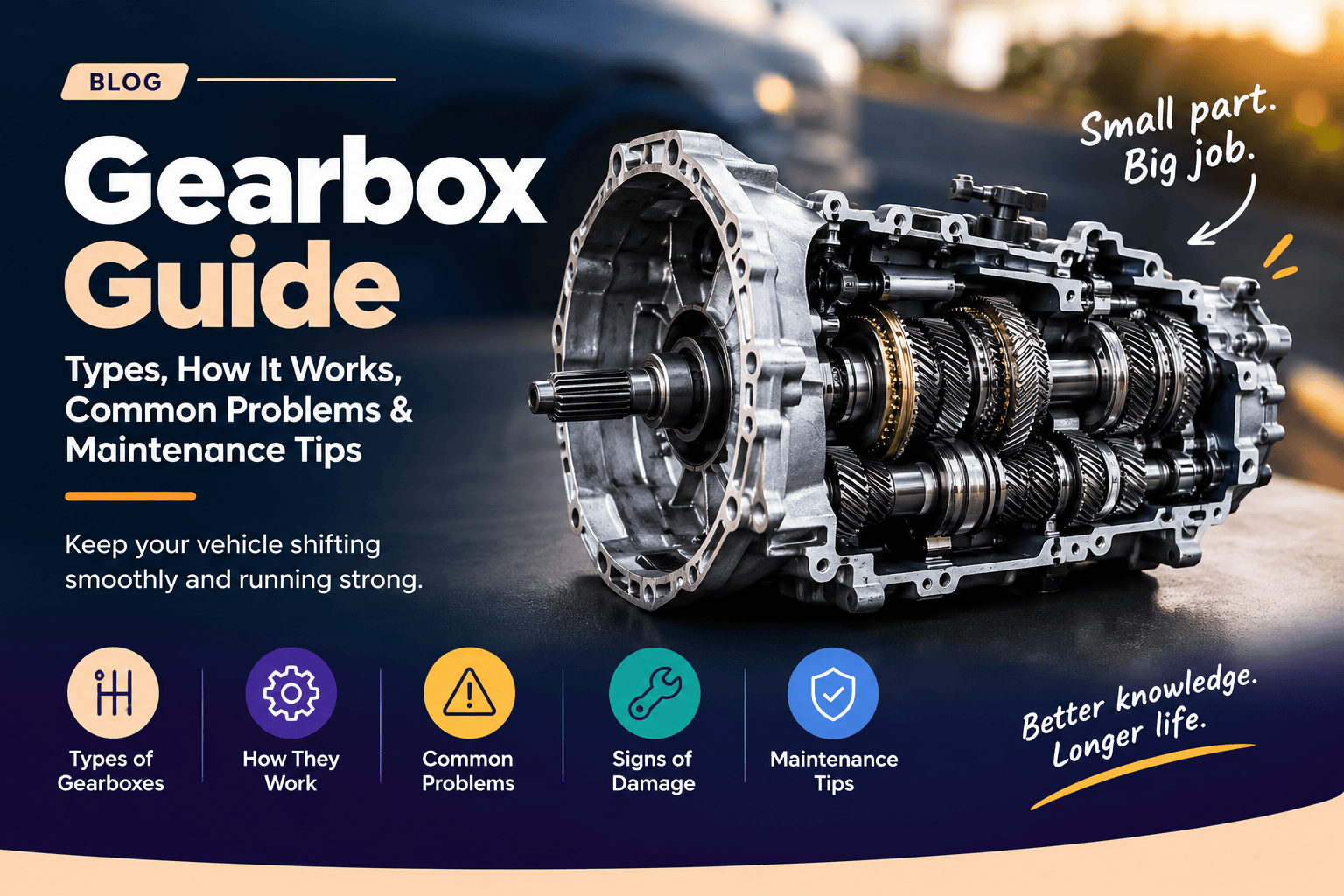
Gearbox Guide: Types, How They Work, Common Problems & Maintenance Tips
Learn what a gearbox is, how it works, and the different types of transmissions, including manual, automatic, CVT, DCT, AMT and EV gearboxes. Discover common gearbox problems, causes of damage, warning signs and essential maintenance tips to extend transmission life.
Post by: Sawiva | 2025-03-04 15:08:06
Gearbox 101: The Heart of Your Car’s Power Transfer
Ever wondered how your engine can be screaming at 3,000 RPM while your car is cruising comfortably down the road?
Meet the gearbox.
Often overlooked until something goes wrong, the gearbox is one of the hardest-working components in your vehicle. It takes the power produced by the engine and makes it usable—whether you need to pull away from a stop, climb a hill, overtake on the highway, or reverse into a parking space.
And just like your wallet after a visit to the mechanic, a gearbox can become expensive very quickly when it is neglected.
So, what exactly does a gearbox do, what types are available, what damages them, and how can you keep yours running smoothly?
Let's shift into gear.
What Is a Gearbox?
A gearbox, also commonly called a transmission, is a mechanical system that transfers power from the engine to the wheels while changing the speed and torque delivered to them.
An engine operates most efficiently within a certain range of speeds. Your wheels, however, need very different amounts of power depending on what the vehicle is doing.
Think about it:
-
Starting from a standstill requires high torque.
-
Cruising at highway speed requires less torque but higher speed.
-
Climbing a hill requires more pulling power.
-
Reversing requires the wheels to rotate in the opposite direction.
The gearbox manages these different requirements by using different gear ratios.
In simple terms:
Engine → Gearbox → Driveshaft/Differential → Wheels
The gearbox acts as the middleman between the engine and the wheels.
And like any good middleman, its job is to make sure everyone gets what they need.
What Does a Gearbox Actually Do?
A gearbox performs several important functions.
1. Controls Speed and Torque
Different gears provide different ratios between engine speed and wheel speed.
Lower gears provide greater torque at the wheels, helping the vehicle accelerate and climb hills.
Higher gears allow the vehicle to travel faster while keeping engine RPM lower.
2. Allows the Vehicle to Reverse
The gearbox contains a mechanism that changes the direction of rotation so that the vehicle can move backward.
Because apparently humans weren't satisfied with only going forward.
3. Keeps the Engine Operating Efficiently
By selecting the appropriate gear, the transmission helps keep the engine within an efficient operating range.
This can improve:
-
Fuel economy
-
Performance
-
Engine longevity
-
Driving comfort
4. Allows the Vehicle to Stop Without Turning Off the Engine
Manual transmissions use a clutch to disconnect the engine from the gearbox when the vehicle is stopped.
Automatic transmissions use systems such as a torque converter and hydraulic/electronic controls to manage this connection.
The Different Types of Gearboxes
Not all gearboxes work the same way.
The major types you'll encounter include:
-
Manual transmission
-
Automatic transmission
-
Continuously Variable Transmission (CVT)
-
Dual-Clutch Transmission (DCT)
-
Automated Manual Transmission (AMT)
-
Single-speed transmissions used in many electric vehicles
Let's break them down.
1. Manual Gearbox
The classic.
A manual transmission uses a set of gears that the driver selects using a gear lever and clutch pedal.
When you press the clutch pedal, the engine is temporarily disconnected from the transmission. You then select a gear and release the clutch while applying the accelerator.
How does it work?
Inside the gearbox are different gear pairs with different ratios.
For example:
1st gear → Maximum torque, low speed
2nd gear → More speed, less torque
3rd gear → More speed
4th/5th/6th gear → Higher cruising speeds
The driver decides when to shift.
Benefits
-
Generally mechanically simple
-
Often cheaper to repair than complex automatic transmissions
-
Good driver control
-
Can provide excellent fuel economy
-
Engine braking is readily available
-
Often durable when properly maintained
Drawbacks
-
Requires more driver involvement
-
Clutch components wear over time
-
Stop-and-go traffic can be tiring
-
Poor clutch technique can cause premature wear
Common problem:
"The clutch is finished."
If you've ever heard a mechanic say this, prepare your wallet emotionally.
2. Automatic Gearbox
An automatic transmission changes gears without requiring the driver to operate a clutch pedal.
The transmission uses components such as:
-
Planetary gearsets
-
Clutches
-
Hydraulic systems
-
Valve bodies
-
Solenoids
-
Electronic control modules
-
Torque converters
Modern automatic transmissions can have anywhere from around four to ten or more forward gears, depending on the design.
How does it work?
A torque converter connects the engine to the transmission and allows the engine to continue running while the vehicle is stopped.
Inside the transmission, planetary gearsets and clutch packs are engaged in different combinations to create different gear ratios.
Electronic control systems monitor things such as:
-
Vehicle speed
-
Engine load
-
Throttle position
-
Transmission temperature
-
Selected driving mode
The transmission then decides when to shift.
Basically, the car is doing the gear-changing thinking so you don't have to.
Benefits
-
Easy and comfortable to drive
-
Excellent for traffic
-
Smooth gear changes in modern systems
-
Can provide good fuel economy
-
Reduces driver workload
Drawbacks
-
More complex than manual transmissions
-
Repairs can be expensive
-
Sensitive to overheating and fluid condition
-
Electronic components can fail
-
Some transmissions require specialized diagnostic equipment
3. CVT — Continuously Variable Transmission
CVT stands for Continuously Variable Transmission.
Unlike a traditional gearbox, a CVT doesn't rely on a fixed set of conventional gears.
Instead, many CVTs use two variable-diameter pulleys connected by a steel belt or chain.
The pulleys continuously change their effective diameter, creating a wide range of gear ratios.
How does it work?
One pulley is connected to the engine.
The other connects to the wheels.
As the vehicle accelerates, the pulley sizes change to provide the appropriate ratio.
Instead of:
1st → 2nd → 3rd → 4th
a CVT can continuously adjust between ratios.
Benefits
-
Smooth acceleration
-
Excellent fuel efficiency in many applications
-
Keeps the engine near an efficient operating range
-
No traditional gear-shift shock
-
Simple driving experience
Drawbacks
-
Some drivers dislike the "rubber-band" feeling
-
Can be sensitive to incorrect fluid
-
Belt/chain and pulley wear can be expensive
-
Overheating can cause serious problems
-
Not all CVTs tolerate aggressive driving well
Important:
CVT fluid is not automatically interchangeable with ordinary automatic transmission fluid.
Using the wrong fluid can cause serious damage.
4. Dual-Clutch Transmission — DCT
A DCT is essentially two transmissions working together.
One clutch typically handles one set of gears while the other handles the remaining gears.
For example:
Clutch 1: 1st, 3rd, 5th, 7th
Clutch 2: 2nd, 4th, 6th
While you're driving in one gear, the next gear can already be prepared.
When the transmission shifts, the clutches alternate.
The result?
Very fast gear changes.
Benefits
-
Extremely quick shifting
-
Excellent performance
-
Good fuel efficiency
-
Minimal interruption of power during shifts
-
Popular in performance vehicles
Drawbacks
-
Complex system
-
Expensive repairs
-
Clutch wear can occur
-
Can sometimes feel jerky at low speeds
-
Sensitive to overheating and poor maintenance
DCTs are brilliant—but they aren't exactly the transmission you want to experiment on with questionable maintenance habits.
5. Automated Manual Transmission — AMT
An AMT is essentially a manual transmission that uses electronic and hydraulic systems to operate the clutch and shift gears automatically.
Think of it as:
Manual gearbox + computers + actuators = AMT
The driver doesn't need to operate the clutch pedal.
Benefits
-
Relatively simple mechanical design
-
Can be cheaper than a traditional automatic
-
Good fuel economy
-
Automated driving experience
Drawbacks
-
Gear changes can feel less smooth
-
Clutch wear remains a concern
-
Shifting may feel slower than a DCT
-
Actuators and electronic systems can fail
6. Single-Speed EV Transmission
Electric vehicles have changed the gearbox conversation.
Most electric vehicles don't need a traditional multi-speed transmission because electric motors can produce useful torque across a very wide speed range.
Many EVs therefore use a single-speed reduction gearbox.
How does it work?
The electric motor spins at very high speed.
The reduction gear lowers the motor's rotational speed and increases torque delivered to the wheels.
There is no need for:
1st → 2nd → 3rd → 4th → 5th
Instead, the system generally uses one fixed reduction ratio.
Benefits
-
Fewer moving parts
-
No traditional gear shifting
-
Smooth acceleration
-
Lower maintenance requirements
-
Excellent efficiency
Drawbacks
-
Still requires lubrication
-
Bearings and gears can wear
-
Repairs can be specialized
-
High-speed electric motor operation places significant demands on components
What Damages a Gearbox?
Gearboxes are strong, but they are not indestructible.
Here are some of the biggest gearbox killers.
1. Low or Incorrect Transmission Fluid
Transmission fluid lubricates components, helps control temperature, and in many automatic transmissions also provides hydraulic pressure.
Low fluid can cause:
-
Increased friction
-
Overheating
-
Poor shifting
-
Clutch damage
-
Gear wear
-
Transmission failure
And using the wrong fluid?
Well let's just say you should be ready to have yourself a little bender.
2. Overheating
Heat is one of the biggest enemies of automatic transmissions.
Excessive heat can degrade transmission fluid and damage internal components.
Overheating can result from:
-
Heavy towing
-
Aggressive driving
-
Low fluid
-
Faulty cooling systems
-
Blocked transmission coolers
-
Internal transmission problems
3. Aggressive Driving
Repeated hard launches, rapid acceleration, harsh shifting and unnecessary abuse can increase stress on the transmission.
Your gearbox may survive a few dramatic launches.
It probably doesn't want a career in motorsport.
4. Incorrect Gear Selection
Selecting the wrong gear at high speed or shifting between Reverse and Drive while the vehicle is still moving can put enormous stress on the transmission.
Always bring the vehicle to a complete stop before changing between Reverse and Drive unless the vehicle manufacturer's instructions specifically allow otherwise.
5. Poor Clutch Habits
Manual transmission drivers can damage their gearbox and clutch through habits such as:
-
Riding the clutch
-
Resting a foot on the clutch pedal
-
Holding the vehicle on a hill using the clutch
-
Launching aggressively
-
Shifting incorrectly
The clutch is not a footrest.
6. Ignoring Warning Signs
A strange noise today can become a very expensive noise tomorrow.
Delaying repairs can allow a small issue to damage multiple internal components.
Signs Your Gearbox May Be Damaged
Your vehicle doesn't have to throw a gearbox onto the road to tell you something is wrong.
Look out for these warning signs:
⚠️ Delayed Gear Engagement
You select Drive or Reverse and there is a noticeable delay before the vehicle moves.
⚠️ Slipping Gears
The engine RPM rises but the vehicle doesn't accelerate as expected.
⚠️ Hard or Jerky Shifting
Gear changes feel unusually aggressive or uncomfortable.
⚠️ Grinding or Whining
Unusual mechanical noises can indicate problems with gears, bearings, fluid levels or other components.
⚠️ Burning Smell
A burning smell may indicate overheated transmission fluid or clutch components.
⚠️ Fluid Leaks
Transmission fluid underneath the vehicle should never simply be ignored.
⚠️ Difficulty Selecting Gears
If a manual transmission becomes difficult to shift, there may be a clutch, linkage, synchronizer or internal transmission issue.
⚠️ Transmission Warning Light
Modern vehicles can detect transmission-related problems through electronic sensors and control systems.
Don't ignore that dashboard warning.
Your car isn't decorating the dashboard.
How to Maintain Your Gearbox
Good maintenance can significantly reduce the risk of expensive transmission problems.
1. Use the Correct Transmission Fluid
Always use the fluid specification recommended by the vehicle manufacturer.
This is especially important for:
-
CVTs
-
DCTs
-
Modern automatic transmissions
"Transmission fluid is transmission fluid" is a dangerous assumption.
2. Check Fluid Levels Where Applicable
Not every modern transmission has a traditional dipstick, and some systems require a specific procedure to check fluid level.
Follow the manufacturer's procedure rather than guessing.
3. Change the Fluid and Filter When Required
Some manufacturers specify transmission-fluid service intervals.
Others may describe certain transmissions as "sealed" or have different service procedures.
The correct interval depends on:
-
Vehicle
-
Transmission type
-
Driving conditions
-
Manufacturer recommendations
If the vehicle is used for towing, heavy loads, extreme temperatures or severe stop-and-go driving, maintenance requirements may be different.
4. Keep the Transmission Cool
Make sure the vehicle's cooling system and transmission cooler are functioning properly.
Excessive heat can dramatically shorten transmission life.
5. Drive Smoothly
Avoid unnecessary:
-
Hard launches
-
Sudden gear changes
-
Aggressive shifting
-
High-speed reversing
-
Towing beyond the vehicle's rated capacity
Your gearbox doesn't need to know that you are late for work.
6. Fix Leaks Early
A small transmission-fluid leak can become a major transmission problem.
If you see fluid underneath the vehicle, have it inspected.
7. Don't Ignore Strange Behaviour
If the transmission starts:
-
Slipping
-
Jerking
-
Delaying engagement
-
Making unusual noises
-
Smelling burnt
-
Struggling to shift
Get it inspected early.
Replacing a seal is generally a much better conversation than replacing an entire transmission.
Gearbox vs Transmission: Are They the Same Thing?
You'll often hear people use the terms gearbox and transmission interchangeably.
In everyday automotive conversations, they generally refer to the same major system.
However, technically, "transmission" can refer to the broader system that transfers engine power to the wheels, while "gearbox" specifically refers to the gear-changing mechanism.
The terminology can also vary between regions.
So if your mechanic says:
"Your transmission is finished."
Don't respond with:
"But I thought it was the gearbox."
You'll probably just make the repair bill longer.
The Bottom Line
Your gearbox is responsible for turning the engine's power into something your wheels can actually use.
Whether your vehicle uses a manual, automatic, CVT, DCT, AMT or EV reduction gearbox, each system has its own advantages, weaknesses and maintenance requirements.
The best way to extend gearbox life is surprisingly simple:
Use the correct fluid. Keep it cool. Drive responsibly. Follow the manufacturer's maintenance schedule. And don't ignore warning signs.
Because when a gearbox works properly, you barely notice it.
When it doesn't?
You'll notice it—and so will your bank account.
Need a Gearbox Part?
Finding the right gearbox component can be just as challenging as diagnosing the problem.
Whether you're looking for a gearbox mount, transmission filter, clutch component, transmission control component, bearing, seal, gear, solenoid or another transmission part, getting the correct part number and specification is critical.
At Sawiva, we help retailers, auto shops, distributors and individual buyers search for automotive spare parts and compare available options and prices.
Don't guess the part. Find the right one.
Visit Sawiva to search for automotive spare parts or contact the Sawiva team for assistance.
Sawiva — Where Innovation Meets Trust and Savings.
Are Brake Pads Universal? Types, Compatibility and How to Choose the Right Ones
Vehicle Longevity, Market Trends, Mechanic Favorites, and Retail Part Strategies

Does Car AC Increase Fuel Consumption? The Truth About Air Conditioning and Fuel Economy