The Exhaust System: Your Car's Way of Saying 'Excuse Me, I Need to Let This Out' (And Why Your Check Engine Light May Not Be What You Think)
Your car’s exhaust system is far more than a collection of pipes making noise—it plays a crucial role in engine performance, emissions control, heat management, and overall vehicle efficiency. In this guide, we break down the key components of the exhaust system, explain how they work together, and explore how exhaust design affects engine performance. From exhaust manifolds and oxygen sensors to catalytic converters, resonators, and mufflers, discover what each component does and why it matters. We’ll also cover common warning signs, maintenance best practices, and what to consider before upgrading your exhaust for better performance.
Post by: Sawiva | 2025-08-06 12:09:42
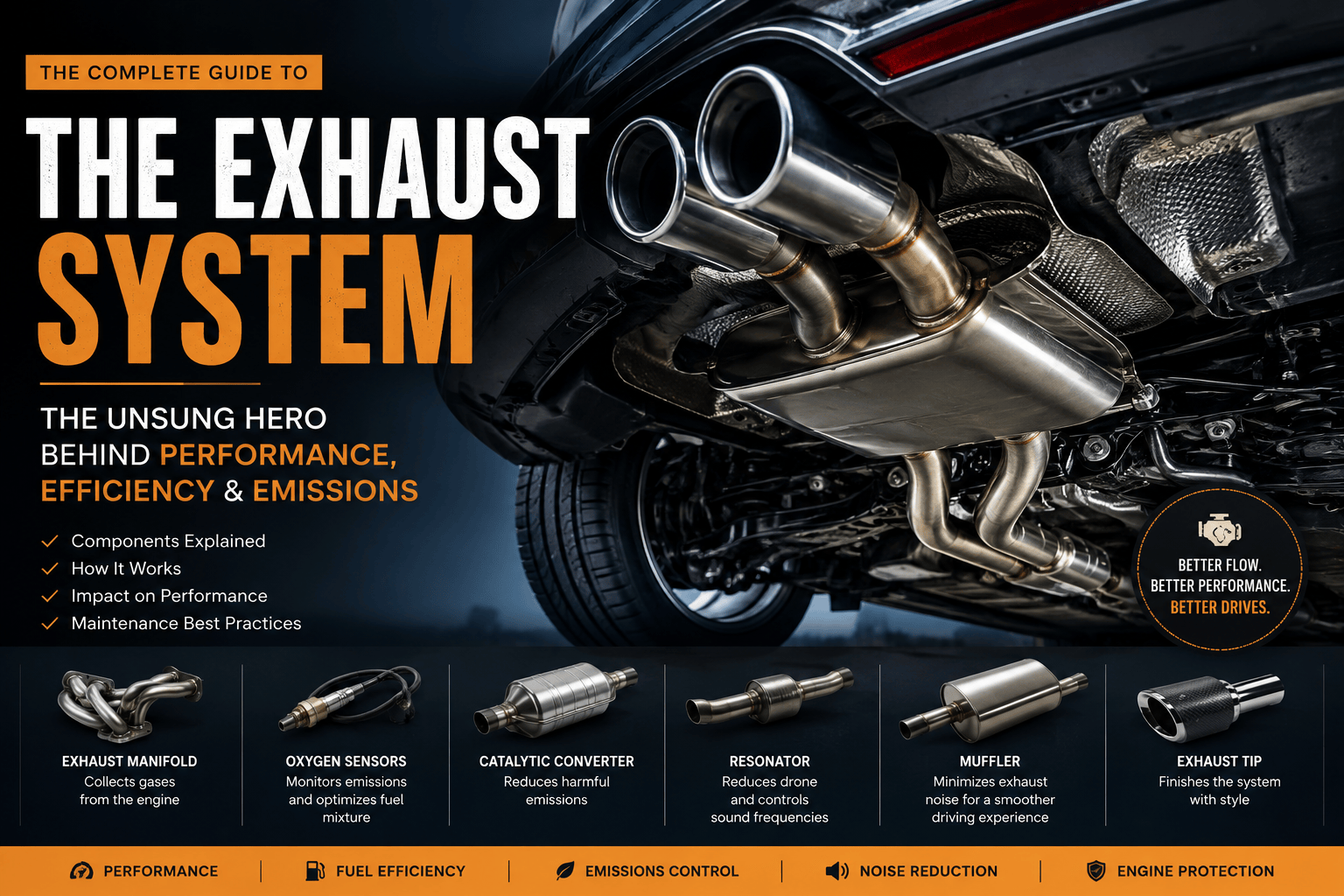
The Exhaust System: Your Car’s Way of Saying, “Excuse Me, I Need to Let This Out.”
Most people think of the exhaust system as the collection of pipes underneath the car that makes the occasional brmmm sound. If that's your understanding of it, you're not entirely wrong—but you're missing most of the story.
The exhaust system is one of the hardest-working systems in a vehicle. It takes the gases produced by combustion, cleans up some of the nastier stuff, manages noise, helps control emissions, and—perhaps surprisingly—can have a meaningful effect on engine performance.
Think of it as your engine's exit strategy.
And like any good exit strategy, it needs to be carefully designed. Too restrictive, and the engine struggles to breathe out. Too open, and you can lose important characteristics such as low-end torque, increase noise, or create emissions and tuning problems.
So, what exactly is hiding underneath your car?
What Does the Exhaust System Actually Do?
Every time your engine burns a mixture of air and fuel, combustion produces gases.
Those gases need somewhere to go.
The exhaust system collects these gases from the engine and directs them away from the vehicle while reducing harmful emissions and controlling noise.
Its main jobs are to:
-
Move exhaust gases away from the engine and passenger compartment
-
Reduce harmful emissions
-
Control exhaust noise
-
Help maintain appropriate exhaust flow
-
Manage exhaust temperatures
-
Support engine efficiency and performance
-
Provide data to the engine management system through sensors
In other words, the exhaust isn't simply where the engine's leftovers go. It is an important part of the engine's breathing system.
And yes, your engine breathes.
It just happens to breathe in through the intake and breathe out through the exhaust—and unlike humans, it does so several thousand times per minute.
The Main Components of an Exhaust System
An exhaust system isn't one long metal pipe. It is a carefully engineered chain of components, each with a specific job.
The exact configuration varies between vehicles, but most modern systems include the following.
1. Exhaust Manifold
The exhaust manifold is where the journey begins.
It is attached directly to the engine's cylinder head and collects exhaust gases from the individual cylinders, bringing them together into a common outlet.
Its design matters more than you might think.
Engineers consider factors such as:
-
Pipe length
-
Pipe diameter
-
Cylinder firing order
-
Gas velocity
-
Exhaust pulse timing
-
Heat management
Performance-oriented engines may use specially designed headers instead of conventional manifolds to improve exhaust flow and scavenging.
Why does this matter?
Because exhaust gases don't leave the cylinders as a smooth stream.
They arrive as pulses.
The timing and shape of those pulses can influence how efficiently the engine clears exhaust gases from the cylinders.
Get the design right, and the engine can breathe more efficiently.
Get it wrong, and your expensive performance engine may effectively be trying to breathe through a straw.
2. Oxygen Sensors
Oxygen sensors, commonly called O2 sensors, monitor the amount of oxygen remaining in the exhaust gases.
The engine control unit (ECU) uses this information to adjust the air-fuel mixture.
This is particularly important for maintaining efficient combustion and controlling emissions.
A faulty oxygen sensor can cause problems such as:
-
Poor fuel economy
-
Rough running
-
Increased emissions
-
Check-engine lights
-
Poor throttle response
-
Incorrect air-fuel mixture
Modern vehicles may have multiple oxygen or air-fuel ratio sensors positioned before and after the catalytic converter.
So if your dashboard suddenly lights up with a check-engine warning, don't immediately blame the mechanic.
Sometimes your exhaust system is the one filing the complaint.
3. Catalytic Converter
This is one of the most important components for emissions control.
The catalytic converter uses chemical reactions to convert harmful combustion by-products into less harmful gases.
Depending on the vehicle and emissions system, it helps reduce pollutants such as:
-
Carbon monoxide
-
Hydrocarbons
-
Nitrogen oxides
Inside the catalytic converter is a structure coated with catalytic materials that provide a large surface area for these reactions.
Why shouldn't you remove it?
Apart from potentially violating emissions regulations, removing or damaging a catalytic converter can cause:
-
Increased emissions
-
Check-engine lights
-
Incorrect sensor readings
-
Poor drivability
-
Exhaust odor
-
Potential tuning problems
And contrary to popular internet wisdom, removing emissions equipment isn't automatically a performance upgrade.
A well-designed exhaust system can provide excellent flow while still doing its job of cleaning the gases.
4. Exhaust Pipes
The pipes connect the various components and carry exhaust gases toward the rear of the vehicle.
Their diameter, length, shape, material and routing all influence the system.
Bigger isn't automatically better.
A pipe that is too small can restrict flow.
But a pipe that is excessively large can reduce exhaust-gas velocity and negatively affect characteristics such as low-speed torque.
This is particularly important for naturally aspirated engines.
The ideal exhaust is therefore not necessarily the biggest one you can fit underneath the car.
It's the one designed for the engine.
5. Resonator
The resonator is primarily concerned with sound.
While the muffler reduces overall exhaust noise, the resonator can target specific frequencies and unwanted tones.
It can help produce a particular exhaust character while reducing unpleasant noises such as:
Exhaust drone
That annoying low-frequency hum that seems to appear at a particular cruising speed.
You know the one.
The sound that makes a 30-minute drive feel like a three-hour meeting.
6. Muffler
The muffler reduces the noise produced by exhaust gases leaving the engine.
Inside, it uses chambers, perforated tubes and carefully designed passages to cancel or reduce sound waves.
Different muffler designs can produce dramatically different sounds.
A performance muffler may reduce restriction while producing a more aggressive exhaust note.
But there's an important distinction:
Louder does not necessarily mean faster.
Your neighbors may believe otherwise.
7. Exhaust Tips
The exhaust tip is the part you can actually see on many cars.
It sits at the end of the system and provides the final outlet for exhaust gases.
It can influence appearance and, depending on its design, the sound characteristics of the exhaust.
But let's be honest: its primary contribution to performance is often giving the owner something shiny to photograph.
How Does the Exhaust System Work?
The entire process begins inside the engine.
Step 1: Combustion
The engine burns air and fuel inside the cylinders.
This produces power—and hot exhaust gases.
Step 2: Exhaust Valve Opens
The exhaust valve opens, allowing the gases to leave the cylinder.
Step 3: Exhaust Manifold Collects the Gases
The manifold collects gases from multiple cylinders and directs them into the exhaust system.
Step 4: Sensors Monitor the Gases
Oxygen or air-fuel ratio sensors measure exhaust conditions and send information to the ECU.
Step 5: Catalytic Converter Cleans Them
The catalytic converter chemically converts harmful pollutants into less harmful substances.
Step 6: Resonator and Muffler Control Noise
The exhaust gases continue through components designed to control sound.
Step 7: Gases Exit the Vehicle
Finally, the gases leave through the exhaust tip.
And then the cycle starts again.
Thousands of times.
Why Is the Exhaust System Necessary?
Without an exhaust system, the engine would still produce combustion gases—but allowing those gases to simply accumulate or discharge directly around the engine would create serious problems.
The exhaust system helps:
Protect the occupants
Exhaust gases can contain dangerous substances, including carbon monoxide.
The system directs gases away from the passenger compartment.
Control emissions
Catalytic converters and other emissions components reduce harmful pollutants released into the atmosphere.
Control noise
Imagine thousands of combustion events per minute with no muffler.
Actually, don't.
Your neighbors would prefer that you didn't.
Support engine operation
Exhaust flow influences cylinder evacuation, combustion efficiency and engine characteristics.
Manage heat
Exhaust gases can be extremely hot. Proper routing and heat shielding help prevent excessive heat from damaging surrounding components.
How Does the Exhaust Affect Performance?
This is where things get interesting.
The exhaust system doesn't create power by itself. Instead, its design influences how effectively the engine can get rid of combustion gases.
Exhaust Restriction
If the exhaust system is excessively restrictive, the engine may have difficulty evacuating exhaust gases.
Potential symptoms can include:
-
Reduced high-RPM performance
-
Poor throttle response
-
Increased exhaust temperatures
-
Reduced efficiency
-
Reduced power
But this does not mean that removing every restriction will automatically produce more power.
Engines are air pumps, and exhaust systems are part of the overall airflow equation.
Exhaust Velocity and Pipe Diameter
One of the biggest misconceptions about performance exhausts is:
"Bigger pipe = more power."
Not necessarily.
Pipe diameter affects exhaust-gas velocity and flow characteristics.
An oversized exhaust may reduce gas velocity and negatively affect performance in some applications, particularly at lower engine speeds.
A properly engineered exhaust balances:
Flow + velocity + pressure + engine displacement + RPM range + camshaft characteristics + turbocharging + tuning.
That's why the ideal exhaust for a 1.2-litre commuter car is unlikely to be ideal for a 6.2-litre performance engine.
Your engine has preferences.
It just doesn't have the courtesy to tell you what they are.
What About Back Pressure?
"Back pressure" is often blamed—or praised—for engine performance.
But the subject is more complicated than the phrase suggests.
Engines generally don't need arbitrary exhaust back pressure to make power.
What they need is properly managed exhaust flow and pressure-wave behavior.
Exhaust design can take advantage of pressure waves and scavenging effects to help remove exhaust gases from the cylinders.
This is one reason exhaust headers, pipe lengths and collector designs can matter so much in performance applications.
So when someone says:
"This engine needs back pressure."
A better question is:
"What exhaust-flow characteristics does this particular engine actually need?"
How the Exhaust Works With Other Parts of the Car
The exhaust doesn't operate in isolation.
It works as part of a much larger ecosystem.
Engine + Intake + Exhaust
The intake brings air into the engine.
The fuel system supplies fuel.
The engine burns the mixture.
The exhaust removes the resulting gases.
It's essentially a carefully synchronized breathing cycle.
Improve one part significantly while ignoring the others, and you may not get the result you expected.
Exhaust + ECU
Modern vehicles rely heavily on electronic engine management.
Sensors in the exhaust provide information to the ECU, which can adjust fueling and other parameters.
This means exhaust modifications can sometimes affect:
-
Fuel trims
-
Air-fuel ratios
-
Sensor readings
-
Engine performance
-
Emissions systems
This is particularly important when making significant modifications.
Exhaust + Turbocharger
Turbocharged engines are particularly sensitive to exhaust design.
The exhaust gases spin the turbocharger turbine, which drives the compressor that forces more air into the engine.
This means the exhaust side directly interacts with turbocharger performance.
A poorly designed exhaust can create excessive restriction.
A properly designed system can help the turbocharger operate more effectively.
However, the ideal design depends on the turbocharger, engine, intended power level and tuning strategy.
Exhaust + Cooling System
Exhaust gases are extremely hot.
Heat from the exhaust can affect nearby components such as:
-
Wiring
-
Sensors
-
Hoses
-
Transmission components
-
Engine bay components
-
Turbocharger systems
That is why exhaust heat shields and proper insulation are not merely decorative pieces of metal.
They have a job.
Signs Your Exhaust System Needs Attention
Your car will often give you clues before an exhaust problem becomes a major repair.
Watch for:
1. Unusual exhaust noise
A sudden roaring, rattling or hissing sound can indicate a leak or damaged component.
2. Exhaust smell inside the cabin
This should never be ignored.
It can indicate an exhaust leak or another problem that is allowing gases into the passenger compartment.
3. Reduced performance
A damaged or restricted exhaust can affect engine performance.
4. Poor fuel economy
A failing oxygen sensor, catalytic converter or exhaust leak can contribute to fuel-economy problems.
5. Check-engine light
Modern exhaust systems contain sensors and emissions components that are monitored by the ECU.
6. Rattling underneath the vehicle
A loose heat shield, damaged muffler or failing catalytic converter can produce rattling noises.
7. Visible rust or damage
Corrosion is especially common in exhaust components because they experience heat, moisture and road contamination.
How to Keep Your Exhaust System Performing at Its Best
You don't need to polish your exhaust every Sunday while whispering motivational quotes to it.
Good maintenance is much simpler.
1. Inspect for Leaks
Regularly check for:
-
Holes
-
Cracks
-
Loose connections
-
Damaged gaskets
-
Broken hangers
Small leaks can become expensive problems.
2. Pay Attention to Unusual Sounds
If your car suddenly sounds like a rally car when you didn't enter a rally, investigate.
A change in exhaust sound can be one of the earliest signs of a problem.
3. Don't Ignore the Check-Engine Light
A warning light can indicate a problem with oxygen sensors, catalytic efficiency, fuel mixture or other components.
Diagnose the actual fault instead of simply clearing the code.
A reset button is not a repair strategy.
4. Protect the System From Excessive Corrosion
Moisture, road salt and contaminants can accelerate corrosion.
Where practical, keep the underside of the vehicle clean, especially after driving through corrosive conditions.
5. Check Exhaust Mounts and Hangers
The exhaust system is suspended underneath the vehicle using brackets, rubber hangers and mounts.
If these fail, the exhaust can move excessively, strike other components or develop stress cracks.
6. Keep the Engine Properly Tuned
An engine that runs excessively rich or otherwise has combustion problems can place additional stress on the catalytic converter and exhaust system.
A healthy engine makes the exhaust system's job much easier.
7. Be Careful With Performance Modifications
If you're upgrading your exhaust, consider the entire vehicle.
Look at:
-
Engine displacement
-
Naturally aspirated vs turbocharged configuration
-
Intended RPM range
-
Power goals
-
Pipe diameter
-
Header/manifold design
-
Catalytic converter
-
Muffler and resonator
-
ECU calibration
-
Emissions requirements
A performance exhaust should be engineered around the engine—not selected purely because it sounds aggressive.
So, Should You Upgrade Your Exhaust?
It depends.
If your existing exhaust is damaged or restrictive, replacing it with a properly designed system can restore lost performance.
If you're modifying a performance vehicle, an appropriately engineered exhaust can contribute to improved airflow and power.
But if you're driving a stock commuter car and someone tells you that installing an enormous pipe will automatically add 30 horsepower, you may want to ask for the dyno sheet before reaching for your wallet.
Because there is a difference between engineering and making noise.
Sometimes they're related.
Sometimes they're very, very far apart.
The Bottom Line
The exhaust system is far more than a collection of pipes hanging underneath your car.
It is an engineered system responsible for:
Moving exhaust gases → controlling emissions → managing heat → reducing noise → providing sensor feedback → supporting engine performance.
It works closely with the engine, intake, fuel system, ECU, turbocharger and cooling system.
And when properly designed and maintained, it helps your engine breathe efficiently while keeping the unpleasant parts of combustion away from you and the environment.
So the next time you hear your car's exhaust, remember:
That noise isn't just your car being dramatic.
It's the final chapter of thousands of tiny explosions happening inside your engine—and the exhaust system is making sure those explosions have somewhere to go.
Take care of it, and your engine will thank you.
Probably not verbally.
But your fuel consumption, performance and wallet might.

Car Radiators Explained: How They Work, Common Problems & When to Replace One

The Mechanic Is Changing: How Electrification Is Reshaping Automotive Repair

The RAM Crisis Is Reaching the Automotive Industry: What It Means for Cars, EVs and the Entire Supply Chain