The Mechanic Is Changing: How Electrification Is Reshaping Automotive Repair
Discover how vehicle electrification is changing mechanic jobs, auto shop hiring, technician skills and the challenges facing vehicle owners.
Post by: Sawiva | 2025-08-06 12:09:42
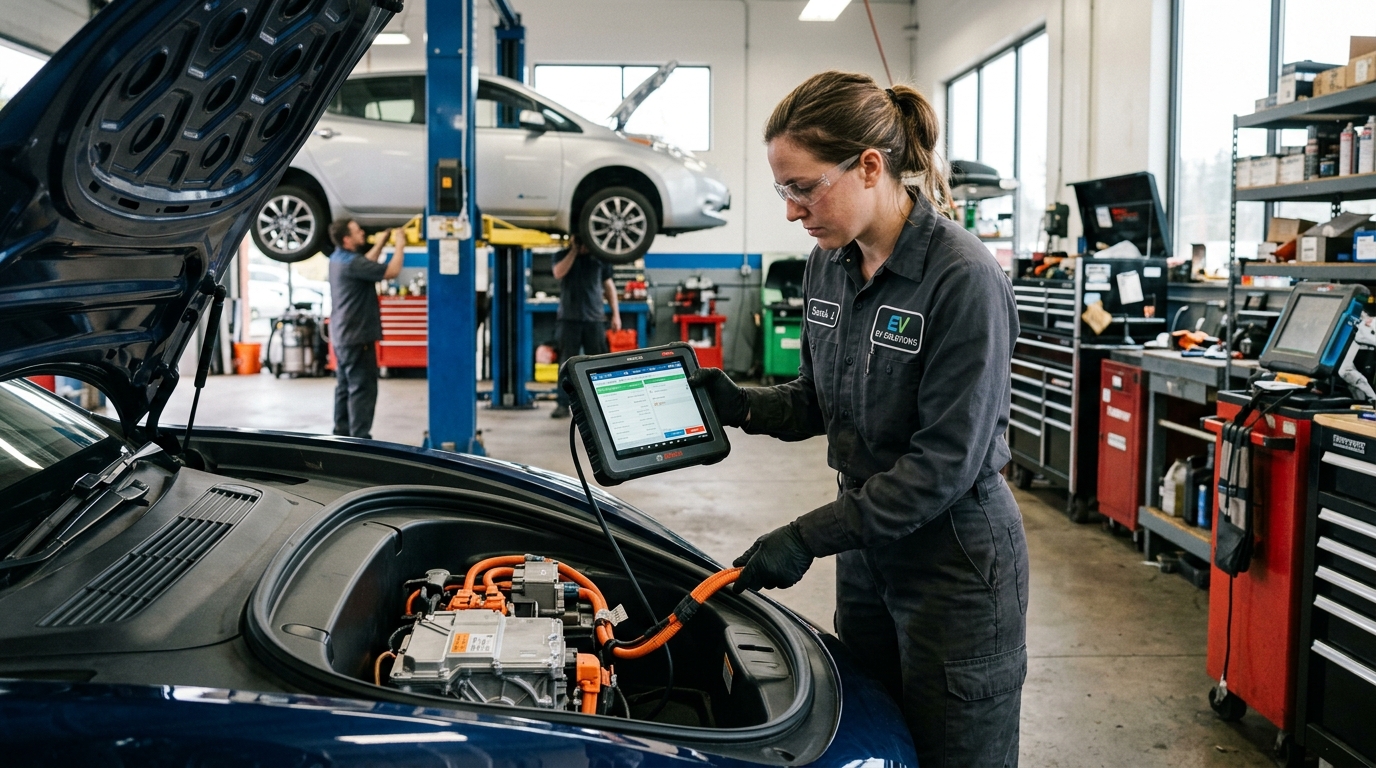
For generations, the automotive mechanic has been associated with engines, oil changes, transmissions, brakes, suspension and the familiar sounds of a combustion engine being brought back to life.
But the automotive industry is entering a different era.
Electrification is changing not only how vehicles are manufactured, but also how they are diagnosed, repaired, maintained—and how automotive businesses hire technicians.
Electric vehicle adoption has reached a scale that makes this transition increasingly difficult for the automotive service industry to ignore. In 2025, global electric-car sales exceeded 20 million, representing approximately one-quarter of all new cars sold worldwide (International Energy Agency [IEA], 2026). Global electric-car production also reached nearly 22 million units in 2025, more than 25% higher than the previous year (IEA, 2026).
For mechanics and auto shops, this creates both challenges and opportunities.
The traditional mechanic isn't necessarily disappearing. The definition of a mechanic is evolving.
From Engines to Electronics
The biggest difference between conventional internal-combustion vehicles and fully electric vehicles is what happens underneath the hood.
A conventional vehicle contains an engine with hundreds of moving components and requires regular servicing of systems such as engine oil, fuel delivery, exhaust, ignition and transmission.
A battery-electric vehicle eliminates or significantly reduces the need for many of these systems. Electric vehicles generally require less routine maintenance because they have fewer moving parts and do not require services such as engine-oil changes (U.S. Department of Energy, n.d.).
That doesn't mean EVs don't need technicians.
It means the type of problem a technician needs to solve is changing.
Instead of primarily diagnosing:
-
Fuel-injection problems
-
Engine timing
-
Oil-pressure problems
-
Exhaust systems
-
Spark plugs
-
Conventional transmission problems
Technicians increasingly encounter:
-
High-voltage battery systems
-
Electric motors
-
Inverters
-
Battery-management systems
-
Charging systems
-
Thermal-management systems
-
Sensors
-
Electronic control systems
-
Software-related faults
-
Advanced driver-assistance systems
The toolbox is changing alongside the vehicle.
The Mechanic Becomes a Technician
One of the biggest changes in automotive repair is the growing importance of electrical and diagnostic knowledge.
A modern technician may need to understand both mechanical systems and computer-controlled systems.
This shift is already reflected in industry training. Automotive Service Excellence (ASE) has emphasized high-voltage safety and EV and hybrid training as part of the industry's response to changing vehicle technology (ASE, 2025).
This creates an important shift.
A mechanic who has spent years repairing engines has valuable experience that shouldn't simply be discarded. Understanding suspension, steering, brakes, drivetrains, cooling systems and vehicle behavior remains important.
But that experience becomes even more valuable when combined with:
Mechanical knowledge + electrical knowledge + diagnostics + technology
That combination can help technicians remain relevant as vehicle technology changes.
Absolutely. I’d add it near the end, after “How Mechanics Can Position Themselves”, because it turns the article from general advice into something mechanics can actually act on.
Staying Ahead: Where Mechanics Can Learn About New Technology
Learning doesn't have to stop when a mechanic leaves the workshop. As automotive technology develops, online technical communities, training platforms and professional networks can help technicians keep up with new diagnostic methods, vehicle systems and repair techniques.
One example is the International Automotive Technicians Network (iATN), a professional community where technicians share diagnostic experiences, discuss difficult repair cases and exchange technical information. It can be particularly useful for mechanics dealing with complex electrical and electronic problems.
Mechanics can also use structured training resources rather than relying exclusively on informal forums. Organizations such as Automotive Service Excellence (ASE) provide information and training resources covering areas including hybrid and electric vehicle technology, diagnostics and high-voltage safety.
Manufacturer technical information is another important resource. As vehicles become increasingly software-driven, technicians may need access to manufacturer repair procedures, service information, wiring diagrams, diagnostic procedures and technical service bulletins.
Online communities can also provide something formal courses cannot always offer: real-world problem solving.
A technician facing an unusual charging fault, sensor problem or intermittent electrical issue can learn from cases that other technicians have already encountered.
The important thing is to be selective about information. Forums can contain valuable practical knowledge, but not every recommendation is necessarily correct or applicable to every vehicle. Safety-critical procedures, particularly those involving high-voltage systems, should be verified against authoritative technical information and appropriate training.
For mechanics, staying competitive in the coming automotive landscape may therefore require a new habit:
Don't just repair today's cars. Keep learning about tomorrow's cars.
This continuous-learning approach can also benefit auto shops. Businesses that encourage technicians to participate in training, professional communities and technology updates can build a workforce that is better prepared for changes in the vehicles entering their workshops.
How Electrification Is Changing How Auto Shops Hire
The hiring process for automotive businesses is changing alongside the vehicles themselves.
Traditionally, an auto shop might look for a mechanic with experience working on particular vehicle brands or conventional systems.
Increasingly, businesses need people who can troubleshoot technology as well as mechanical components.
The U.S. Department of Energy's 2025 United States Energy & Employment Report found that 91% of employers in the motor-vehicle repair and maintenance industry reported that hiring workers was difficult, with 55% describing hiring as "very difficult." The most frequently cited reason was a lack of experience, training or technical skills (U.S. Department of Energy, 2025).
This creates a new hiring equation.
Instead of asking only:
"How many years have you been a mechanic?"
An auto shop may increasingly need to ask:
"What technologies can you diagnose?"
Can the technician safely work around high-voltage systems?
Can they use diagnostic software?
Can they interpret sensor data?
Can they understand electrical diagrams?
Can they diagnose a fault rather than simply replace a component?
Can they work on conventional, hybrid and electric vehicles?
These questions can become important differentiators when shops are hiring.
Why Traditional Experience Still Matters
It would be a mistake to assume that electrification makes traditional mechanical knowledge irrelevant.
It doesn't.
Electric vehicles still have:
-
Suspension systems
-
Steering systems
-
Braking systems
-
Wheel bearings
-
Tires
-
Cooling systems
-
Air conditioning
-
Body components
-
Electrical wiring
-
Sensors
-
Drivetrain components
-
Software-controlled systems
Hybrid vehicles also combine electric technology with an internal-combustion engine.
The technician of the future therefore doesn't necessarily have to choose between being a "mechanic" or an "EV technician."
The opportunity is to become both.
How Mechanics Can Position Themselves
The most important step for mechanics is to start learning before new technology becomes unavoidable in their local market.
1. Learn Automotive Electrical Systems
Understanding voltage, current, resistance, circuits, sensors, relays, wiring diagrams and electrical testing provides a foundation for working with modern vehicles.
A mechanic who understands why an electrical system behaves a certain way is in a much stronger position than someone who simply learns which component to replace.
2. Learn EV and Hybrid Safety
High-voltage systems introduce safety considerations that are different from traditional 12-volt automotive electrical systems.
Training should cover proper isolation procedures, protective equipment, identification of high-voltage components and safe diagnostic practices.
Industry training organizations have increasingly emphasized high-voltage safety and EV/hybrid training as vehicle electrification expands (ASE, 2025).
3. Become Comfortable With Diagnostic Technology
The modern mechanic needs to be comfortable using:
-
OBD diagnostic equipment
-
Manufacturer diagnostic software
-
Multimeters
-
Oscilloscopes
-
Battery diagnostic tools
-
Scan tools
-
Vehicle-data systems
Knowing how to interpret information is increasingly as important as knowing how to use a wrench.
4. Understand Battery Technology
Technicians don't necessarily need to become battery engineers.
However, understanding battery health, battery-management systems, charging behavior, thermal management and common battery-related faults can create valuable expertise.
5. Keep Learning
The automotive industry is moving quickly.
The mechanic who stops learning after qualifying may eventually find that their original training covers only part of the vehicles entering the workshop.
Training should therefore become an ongoing part of the profession rather than something that ends after apprenticeship or technical school.
Auto Shops Have to Change Too
The responsibility doesn't fall entirely on mechanics.
Auto shops need to rethink how they recruit, train and retain technicians.
Training
Technicians need opportunities to learn new vehicle technologies.
Equipment
EV diagnostics and high-voltage work can require specialized tools and safety equipment.
Information
Technicians need access to accurate repair procedures, wiring diagrams, diagnostic information and manufacturer specifications.
Mentorship
Experienced technicians can help newer workers develop practical mechanical skills, while newer technicians may bring stronger familiarity with digital tools and emerging technologies.
This creates an opportunity for different generations of technicians to complement one another.
The New Challenge: Finding the Right Mechanic
Electrification also creates a problem for vehicle owners.
Imagine a customer receives a warning related to their battery, charging system or vehicle electronics.
Who do they call?
Their traditional mechanic?
The dealership?
An EV specialist?
An auto electrician?
A mobile technician?
A general repair shop?
This question becomes more complicated as vehicle technology diversifies.
Customers may know that something is wrong with their vehicle without knowing what type of specialist they actually need.
That creates a potential gap between vehicle owners and qualified technicians.
The Problem Isn't Just Finding a Mechanic
Finding a mechanic has always involved questions about trust and expertise.
Modern vehicles add another layer:
Does the technician actually have the equipment, information and training required to diagnose this particular problem?
A customer could find a workshop that advertises "EV repair" but still need to determine whether that shop has experience with their particular vehicle.
This becomes especially important for independent repair businesses competing with dealerships.
As vehicles become more complex, customers need better ways to identify technicians based on actual capabilities, rather than simply proximity.
This Could Change How Auto Shops Market Themselves
For years, an auto shop's marketing might have looked like:
Engine Repair
Brake Repair
Oil Changes
Suspension
Transmission
The future may require more specific positioning:
Hybrid Diagnostics
EV Diagnostics
Battery Testing
Automotive Electrical Systems
ADAS Calibration
Computer Diagnostics
The ability to clearly communicate technical capabilities can become an important competitive advantage.
A technician shouldn't only say:
"I'm a mechanic."
They can increasingly demonstrate:
"I specialize in electrical diagnostics, hybrid systems and advanced vehicle diagnostics."
That distinction can help customers and employers understand what the technician is actually capable of handling.
The Opportunity for Younger Mechanics
Electrification may also create new entry points into the automotive industry.
Someone who enjoys electronics, computers, diagnostics and technology may previously have considered automotive repair too mechanical.
Modern vehicles blur that distinction.
The future technician could have knowledge across several disciplines:
**Automotive mechanics
-
Electrical systems
-
Computer diagnostics
-
Software
-
Data interpretation**
The automotive technician is becoming increasingly multidisciplinary.
What Happens to Traditional Repairs?
Traditional vehicles won't disappear overnight.
Millions of combustion-engine vehicles will remain on roads for many years, meaning there will continue to be demand for technicians who understand conventional engines, transmissions and fuel systems.
At the same time, the global transition is accelerating. In 2025, electric vehicles accounted for approximately 25% of new-car sales worldwide, continuing a multiyear growth trend (IEA, 2026).
This means mechanics are likely to operate in a mixed automotive environment for years:
ICE vehicles + hybrids + plug-in hybrids + EVs
The most adaptable technicians may therefore be those capable of working across multiple technologies.
The Future Mechanic Isn't Replaced—They Are Upgraded
The automotive industry has changed many times.
Carburetors gave way to fuel injection.
Mechanical ignition systems gave way to electronic ignition.
Basic diagnostics evolved into computer diagnostics.
Manual systems became electronically controlled.
Electrification is another step in that evolution.
The biggest risk for a mechanic may not be that electric vehicles eliminate their profession.
It may be refusing to evolve alongside the vehicles they repair.
The mechanic who learns new technologies, invests in diagnostics, understands electrical systems and continues developing their skills can remain valuable as the vehicles around them change.
And for auto shops, the challenge is equally clear: finding, training and retaining technicians who can bridge traditional mechanical expertise with modern automotive technology.
For customers, however, another question remains:
As vehicles become smarter, how do we make it easier to find the right person to fix them?
That may become one of the automotive industry's biggest opportunities—connecting vehicle owners with technicians and workshops based not just on location, but on the specific technology, expertise and equipment required to solve their problem.
The future of automotive repair isn't simply electric.
It's more specialized, more connected and more dependent on knowledge.
And the mechanics who prepare for that future today will be better positioned to serve the vehicles of tomorrow.
References
-
Automotive Service Excellence. (2025). ASE education foundation updates accreditation standards addressing high-voltage EV/hybrid safety and training resources. ASE
-
International Energy Agency. (2026). Global EV outlook 2026. IEA. International Energy Agency
-
U.S. Department of Energy. (2025). 2025 United States energy & employment report. U.S. Department of Energy report
-
U.S. Department of Energy. (n.d.). Electric vehicle maintenance. Alternative Fuels Data Center. Alternative Fuels Data Center
The Mechanic Is Changing: How Electrification Is Reshaping Automotive Repair
The RAM Crisis Is Reaching the Automotive Industry: What It Means for Cars, EVs and the Entire Supply Chain
The Different Oils and Fluids Used in a Car and What They Do