Engine Oil Explained: Types, How to Choose the Right Oil and Warning Signs Your Engine Is Being Damaged
Learn about mineral, synthetic and semi-synthetic engine oils, understand oil viscosity ratings, discover what to check before buying and identify warning signs of engine oil-related engine damage
Post by: Sawiva | 2025-08-06 12:09:42
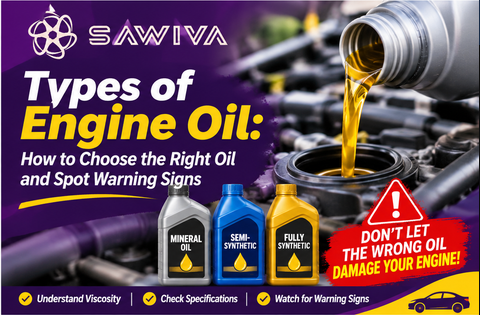
Engine oil is one of the most important fluids in your vehicle. Whether you drive a Toyota Corolla, Nissan X-Trail, Subaru Forester, Mercedes-Benz C-Class or Volkswagen Tiguan, your engine depends on the right oil to operate efficiently and reliably.
But with so many options available, choosing engine oil can be confusing. You'll find products labelled 5W-30, 10W-40, 15W-40, fully synthetic, semi-synthetic, mineral oil, high mileage and diesel engine oil.
Does a more expensive engine oil necessarily mean better protection? Is thicker oil better for an older engine? Can using the wrong engine oil damage your vehicle?
The short answer is yes, choosing the wrong oil can contribute to premature engine wear, overheating, sludge formation and even engine failure.
In this guide, we'll explore the different types of engine oil, what the numbers and ratings on oil containers mean, what to consider when buying engine oil and the warning signs that your oil may be harming your engine.
1. What Does Engine Oil Actually Do?
Engine oil does much more than lubricate moving engine components. It performs several essential functions:
-
Lubrication: Creates a protective film between moving metal components, reducing friction and wear.
-
Cooling: Helps carry heat away from components such as pistons and bearings.
-
Cleaning: Suspends dirt, soot and combustion by-products to prevent harmful deposits from accumulating.
-
Corrosion protection: Helps protect internal engine surfaces from rust and corrosion.
-
Sealing: Helps maintain the seal between piston rings and cylinder walls.
-
Noise reduction: Reduces friction and contact between moving engine components.
Without adequate lubrication, engine components can experience excessive friction, heat and wear.
This is why checking your oil level and following the recommended oil change intervals are essential parts of vehicle maintenance.
2. What Are the Different Types of Engine Oil?
Engine oils are generally classified according to their base oil composition and formulation.
The four common categories are mineral oil, semi-synthetic oil, fully synthetic oil and high-mileage engine oil.
A. Mineral Engine Oil (Conventional Oil)
Mineral oil is produced by refining crude petroleum to create a lubricant suitable for internal combustion engines.
It is generally more affordable than synthetic alternatives and is commonly used in older engine designs that specify conventional lubricants.
Advantages:
-
Generally affordable and widely available.
-
Suitable for engines designed to use conventional oil.
-
Can be appropriate for certain older vehicles.
Disadvantages:
-
Generally offers lower resistance to oxidation and thermal breakdown than high-performance synthetic formulations.
-
May require more frequent oil changes, depending on the manufacturer's recommendations and operating conditions.
-
May offer less protection under demanding operating conditions.
Best suited for: Older vehicles whose manufacturers specifically recommend mineral engine oil.
B. Semi-Synthetic Engine Oil (Synthetic Blend)
Semi-synthetic oil, also known as synthetic blend oil, combines mineral base oil with synthetic base oil.
It offers a balance between cost and performance.
Compared with conventional mineral oil, synthetic blends can offer improved oxidation resistance and temperature performance, depending on their formulation.
Advantages:
-
Usually more affordable than fully synthetic oil.
-
Offers improved performance over many conventional formulations.
-
Suitable for vehicles whose manufacturers approve the particular oil specification.
Disadvantages:
-
Generally does not offer all the performance advantages of premium fully synthetic formulations.
-
Quality and performance vary between products.
Best suited for: Vehicles whose manufacturers recommend a synthetic blend or approve its particular specifications.
C. Fully Synthetic Engine Oil
Fully synthetic oil is engineered using highly refined or chemically modified base oils and carefully selected additives.
It is designed to provide consistent lubrication and performance across a wide range of operating temperatures.
It is particularly useful in engines operating under demanding conditions, including many modern turbocharged engines.
Advantages:
-
Excellent resistance to oxidation and thermal breakdown.
-
Good performance during cold starts.
-
Helps control sludge and engine deposits.
-
Available in formulations designed for modern turbocharged and high-performance engines.
-
Can support longer oil change intervals where the manufacturer permits them.
Disadvantages:
-
Generally more expensive than conventional mineral oil.
-
Not every fully synthetic oil is suitable for every engine.
Best suited for: Modern engines, turbocharged vehicles and vehicles whose manufacturers specify synthetic lubricants.
D. High-Mileage Engine Oil
High-mileage engine oil is formulated for engines with significant accumulated mileage, particularly those experiencing age-related oil consumption or seal deterioration.
Depending on the formulation, it may contain additives designed to condition seals, reduce deposits and control oil consumption.
Advantages:
-
Formulated to address certain age-related engine issues.
-
May help reduce minor oil seepage associated with deteriorated seals.
-
Can provide additional deposit and wear protection.
Disadvantages:
-
Cannot repair damaged seals, worn piston rings or other mechanical faults.
-
May not be appropriate for every older engine.
Best suited for: Higher-mileage vehicles where the oil meets the manufacturer's required viscosity and performance specifications.
Important: High-mileage oil is not automatically thicker oil. Always check its SAE viscosity grade and vehicle compatibility.
3. Understanding Engine Oil Viscosity: What Do 5W-30, 10W-40 and 15W-40 Mean?
One of the most important things to understand when buying engine oil is viscosity.
Viscosity describes how easily oil flows. In simple terms, it determines how thick or thin the oil is under specific temperature conditions.
You'll commonly find viscosity grades such as:
-
0W-20
-
5W-30
-
5W-40
-
10W-30
-
10W-40
-
15W-40
-
20W-50
These numbers are defined by the Society of Automotive Engineers (SAE).
Let's use 5W-30 as an example.
The first number (5W):
The W stands for winter. This number describes the oil's low-temperature viscosity characteristics and its ability to flow during cold starts.
A lower W number generally means better low-temperature flow performance.
The second number (30):
This represents the oil's high-temperature viscosity grade, measured under standardized conditions.
A higher second number generally indicates a thicker oil at operating temperature.
Common engine oil viscosity grades
| Viscosity | General characteristics |
|---|---|
| 0W-20 | Low-viscosity oil commonly specified for newer fuel-efficient engines. |
| 5W-30 | Common in modern petrol and diesel engines, depending on specification. |
| 5W-40 | Offers a higher operating-temperature viscosity than 5W-30. |
| 10W-30 | Used in engines specifying this viscosity grade. |
| 10W-40 | Common in various older and newer engine applications. |
| 15W-40 | Commonly found in certain diesel and commercial engine applications. |
| 20W-50 | A relatively high-viscosity grade used in engines specifically designed or approved for it. |
These grades are not interchangeable recommendations. The correct choice depends on your vehicle's engine design, manufacturer's requirements and operating conditions.
A common misconception: Many motorists believe that older engines automatically need thicker oil. This is not necessarily true. Switching from 5W-30 to 20W-50 without checking manufacturer specifications can interfere with oil circulation and lubrication.
4. Understanding Engine Oil Quality Ratings
Apart from viscosity, engine oil has performance classifications that tell you whether it meets particular lubrication and engine protection standards.
Two important classification systems are API and ACEA.
A. API (American Petroleum Institute)
API classifies engine oils according to their performance and intended application.
For petrol engines, the classification begins with the letter S.
Examples include:
-
API SQ
-
API SP
-
API SN
-
API SM
API SQ is the newer petrol engine oil service category, introduced in 2025. API SQ oils are designed to provide improved protection against timing chain wear, low-speed pre-ignition and high-temperature engine deposits.
For diesel engines, the classification generally begins with the letter C.
Examples include:
-
API CK-4
-
API CJ-4
-
API CI-4
Some oils are formulated to meet both petrol and diesel engine requirements.
Always check the vehicle manufacturer's required category. Newer petrol oil categories are generally backward compatible with older petrol categories, but diesel specifications have important exceptions.
For example, API FA-4 diesel oils are not interchangeable with API CK-4 oils.
B. ACEA (European Automobile Manufacturers' Association)
ACEA specifications are particularly important when buying oil for European vehicles.
You'll commonly encounter:
-
ACEA A/B: For certain petrol and light-duty diesel engines.
-
ACEA C: For engines requiring oils compatible with specific exhaust after-treatment systems, including certain diesel particulate filters.
-
ACEA E: For heavy-duty diesel engines.
Some manufacturers also require their own specific oil approvals, such as Volkswagen, Mercedes-Benz and BMW specifications.
For example, a Mercedes-Benz engine may require an oil carrying a particular MB-Approval specification. Simply buying a fully synthetic 5W-30 oil does not guarantee compatibility.
5. What Should You Look Out for When Buying Engine Oil?
Choosing the right engine oil involves more than comparing prices or selecting a familiar brand.
Here are seven important things to check before purchasing.
1. Check Your Vehicle Manufacturer's Recommended Viscosity
Start with your owner's manual or the manufacturer's official oil recommendation.
If your vehicle specifies 5W-30, don't automatically switch to 10W-40 because someone recommends thicker oil.
Using an unsuitable viscosity can affect oil circulation, lubrication and engine performance.
2. Check the API and ACEA Specifications
Look beyond the viscosity printed on the container.
Make sure the oil meets the required performance classification.
For example, an engine requiring API SQ or a particular ACEA specification should receive oil that meets the relevant requirement.
3. Check Manufacturer-Specific Approvals
Some engines require specific manufacturer approvals.
This is especially important when buying oil for:
-
Volkswagen and Audi.
-
BMW.
-
Mercedes-Benz.
-
Porsche.
-
Volvo.
A product claiming to be suitable for a particular brand is not necessarily officially approved by that manufacturer.
Check the exact specification required by your engine.
4. Buy from Reputable Suppliers
Counterfeit and substandard lubricants can put your engine at risk.
When buying engine oil:
-
Purchase from reputable distributors and automotive retailers.
-
Check that the manufacturer's seal is intact.
-
Inspect the packaging for poor printing, spelling mistakes or suspicious labelling.
-
Check the batch number and manufacturing details.
-
Look for tampering around the cap and seal.
-
Verify the product with the manufacturer where authentication services are available.
Avoid unusually cheap products from unverified sellers.
5. Consider Your Vehicle's Mileage and Condition
An older vehicle may have different lubrication requirements from a newer one.
If your engine consumes oil, leaks or produces excessive smoke, have it inspected before changing viscosity grades.
High-mileage engine oil may help with certain age-related issues, but it cannot replace mechanical repairs.
6. Consider Your Driving Conditions
Driving conditions influence how quickly engine oil deteriorates.
For motorists in Kenya, consider:
-
Frequent traffic congestion and stop-start driving.
-
Long periods of idling.
-
Dusty roads and environments.
-
Frequent short journeys.
-
Heavy loads and demanding driving conditions.
These may qualify as severe operating conditions, depending on the manufacturer's definition.
Follow the relevant severe-service maintenance schedule where applicable.
7. Check the Manufacturing and Expiry Information
Inspect the packaging and product condition before purchasing.
Check the batch number, manufacturing date and any stated shelf-life information.
Avoid containers that are damaged, leaking, tampered with or stored in questionable conditions.
6. Signs Your Engine Oil May Be Causing Engine Damage
Using unsuitable, contaminated or degraded engine oil can contribute to serious engine problems.
However, it is important to understand that these symptoms do not automatically prove that engine oil is the cause. Other mechanical faults can produce similar warning signs.
Here are some symptoms worth taking seriously.
A. Engine Knocking or Tapping Noises
Unusual knocking, ticking or tapping sounds can indicate insufficient lubrication or excessive wear in engine components.
When the oil is too thin, too thick or unable to maintain an adequate lubricating film, components may experience increased metal-to-metal contact.
Potential causes include:
-
Incorrect oil viscosity.
-
Low oil levels.
-
Degraded engine oil.
-
Low oil pressure.
-
Worn engine bearings or valve-train components.
What to do: Stop driving if the knocking is severe or accompanied by an oil-pressure warning. Have the engine inspected before continuing.
B. Oil Pressure Warning Light
The oil pressure warning light is one of the most serious dashboard warnings.
It may indicate that the engine is not receiving sufficient oil pressure to lubricate critical components.
Possible causes include:
-
Insufficient engine oil.
-
Incorrect oil viscosity.
-
A failing oil pump.
-
A blocked oil filter or oil passage.
-
Excessive internal engine wear.
-
Oil pressure sensor faults.
What to do: Safely stop the vehicle and switch off the engine immediately. Check the oil level once safe. If the warning remains or returns, do not continue driving. Arrange professional inspection.
C. Excessive Blue or Greyish Exhaust Smoke
Blue or blue-grey exhaust smoke can indicate that engine oil is entering the combustion chamber and burning alongside fuel.
This may be associated with:
-
Worn piston rings.
-
Damaged valve stem seals.
-
Turbocharger oil seal problems.
-
Excessive oil entering the intake system.
Incorrect oil specifications or overfilling may contribute to certain oil consumption problems, but blue smoke often indicates an underlying mechanical issue.
What to do: Have the engine inspected to establish where the oil is entering the combustion process.
D. Excessive Engine Oil Consumption
If you regularly need to top up engine oil between scheduled services, your vehicle may have an underlying problem.
Possible causes include:
-
External oil leaks.
-
Worn piston rings.
-
Damaged valve seals.
-
Turbocharger problems.
-
Oil viscosity unsuitable for the engine.
-
Excessive engine wear.
What to do: Monitor the oil level and how much oil the engine consumes. Have the vehicle inspected rather than repeatedly topping up without investigating the cause.
E. Sludge and Thick Deposits Inside the Engine
Engine sludge is a thick, dark deposit that can accumulate inside an engine when oil deteriorates or becomes contaminated.
It can develop due to:
-
Extended oil change intervals.
-
Poor-quality or unsuitable lubricants.
-
Excessive heat.
-
Fuel or coolant contamination.
-
Poor engine maintenance.
Sludge can restrict oil passages and interfere with proper lubrication.
What to do: Have a qualified mechanic inspect the engine. Avoid aggressive chemical engine flushes without professional assessment, particularly in heavily sludged engines.
F. Engine Overheating
Engine oil helps transfer heat away from moving engine components.
When lubrication is inadequate, friction and component temperatures can increase.
However, overheating can also be caused by:
-
Coolant leaks.
-
A faulty thermostat.
-
Radiator problems.
-
Cooling fan failure.
-
Water pump problems.
What to do: Stop safely if the engine temperature rises into the danger zone. Do not open a hot radiator cap. Have both the lubrication and cooling systems checked.
G. Metallic Particles in Used Engine Oil
Metallic particles in engine oil may indicate that internal engine components are wearing excessively.
Some fine wear material can occur during normal operation, but visible metal flakes or significant metallic debris should never be ignored.
Potential sources include:
-
Engine bearings.
-
Camshafts.
-
Crankshaft components.
-
Timing chain components.
What to do: Arrange an engine inspection and, where appropriate, professional oil analysis to determine the type and extent of contamination.
7. Common Engine Oil Mistakes That Can Damage Your Vehicle
Even motorists who service their vehicles regularly can make mistakes when choosing or maintaining engine oil.
Avoid these common practices:
-
Using the wrong viscosity: Choosing oil based on thickness rather than manufacturer specifications.
-
Mixing incompatible oils: Mixing products with different specifications or additive systems without checking compatibility.
-
Ignoring oil change intervals: Continuing to use degraded oil beyond the recommended service interval.
-
Overfilling the engine: Excessive oil can cause foaming, increased crankcase pressure and other problems.
-
Driving with low oil levels: Insufficient oil can cause severe internal engine wear.
-
Ignoring oil warning lights: Continuing to drive with low oil pressure can destroy an engine.
-
Using counterfeit lubricants: Poor-quality products may not provide the protection claimed on their packaging.
-
Using aftermarket additives unnecessarily: Additional additives may interfere with the carefully balanced formulation of engine oil.
8. How Often Should You Change Your Engine Oil?
There is no single oil change interval that applies to every vehicle.
The recommended interval depends on:
-
Engine design.
-
Type and specification of engine oil.
-
Vehicle age and mileage.
-
Driving conditions.
-
Manufacturer recommendations.
Some vehicles have fixed service intervals, while others use oil-life monitoring systems.
If you regularly drive in congested Nairobi traffic, operate on dusty roads or make frequent short journeys, your vehicle may fall under its manufacturer's severe-service maintenance schedule.
Do not assume that fully synthetic oil automatically allows you to extend the manufacturer's recommended oil change interval.
Always change the oil filter according to the vehicle manufacturer's service recommendations.
9. Final Thoughts: Choosing the Right Engine Oil Protects Your Investment
Engine oil is not simply another maintenance expense. It is a critical component of your vehicle's long-term reliability.
Whether you choose mineral, semi-synthetic or fully synthetic oil, the most important consideration is whether it meets your engine manufacturer's specifications.
Before purchasing engine oil, check its viscosity, API or ACEA classification, manufacturer approvals and authenticity.
Most importantly, pay attention to warning signs such as unusual engine noises, excessive oil consumption, blue exhaust smoke and oil pressure warnings.
A small investment in the right lubricant and regular maintenance can help prevent expensive engine repairs.
Looking for the right engine oil for your vehicle?
At Sawiva, you can compare automotive products and explore options from suppliers to make more informed purchasing decisions.
Visit Sawiva to explore automotive products and find parts and supplies for your vehicle.
Sawiva – Where Innovation Meets Trust and Savings.
Engine Oil Explained: Types, How to Choose the Right Oil and Warning Signs Your Engine Is Being Damaged

Are Brake Pads Universal? Types, Compatibility and How to Choose the Right Ones

Vehicle Longevity, Market Trends, Mechanic Favorites, and Retail Part Strategies