The Different Oils and Fluids Used in a Car and What They Do
Discover the different oils and fluids your car needs and understand what each one does. From engine oil, coolant and brake fluid to transmission fluid, differential oil and A/C refrigerant, this guide explains their purpose, why they matter, signs of fluid problems, and how using the correct fluid can help keep your vehicle safe, reliable and running efficiently.
Post by: Sawiva | 2025-08-06 12:09:42
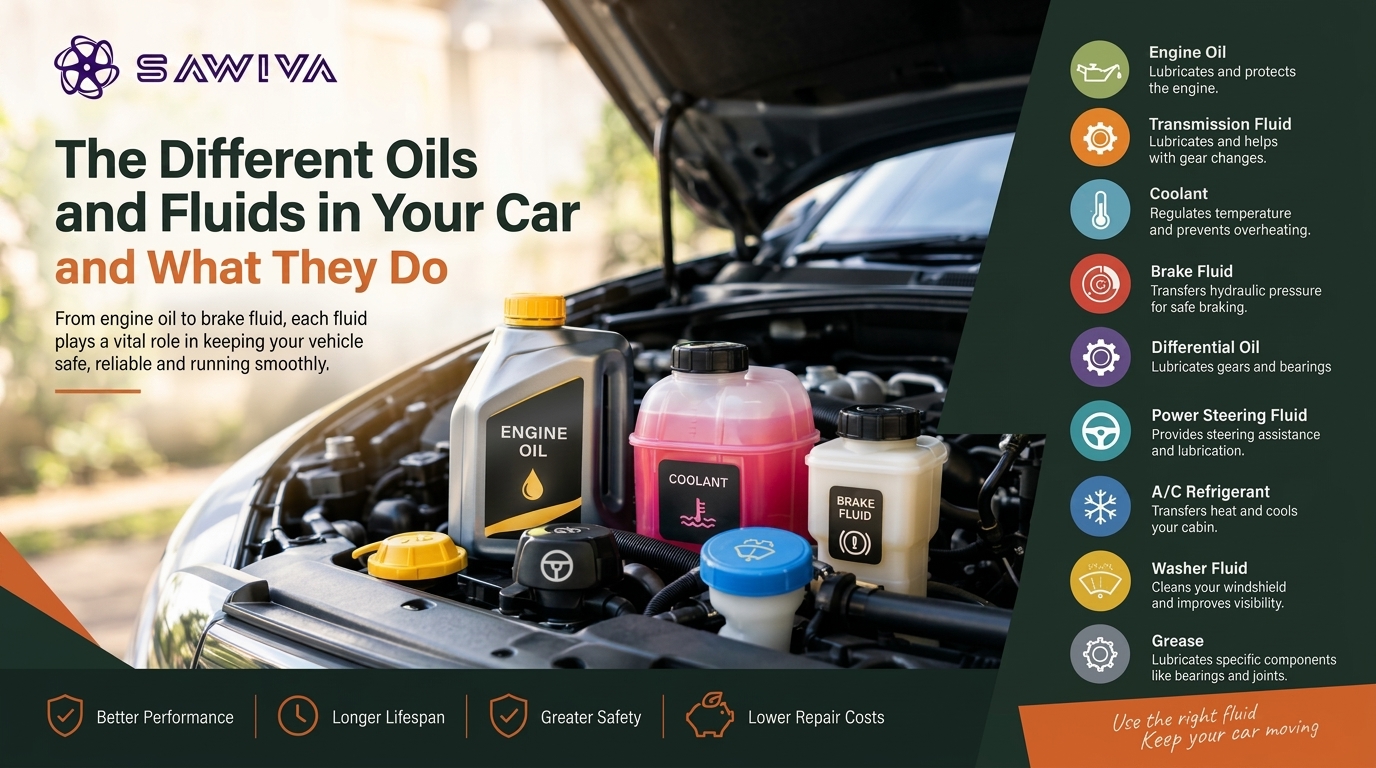
A modern car relies on much more than fuel to keep moving. Under the bonnet and throughout the vehicle are several different oils, fluids and lubricants, each designed to perform a specific job.
Some reduce friction between moving components, others control temperature, transfer hydraulic pressure, prevent corrosion, or help critical systems operate smoothly. Running low on the wrong fluid—or using the wrong type—can lead to poor performance, expensive repairs and, in some cases, complete component failure.
Understanding the different car oils and fluids and their purposes can help you maintain your vehicle properly and identify potential problems before they become serious.
1. Engine Oil
Purpose: Lubricates and protects the engine's moving components.
Engine oil is one of the most important fluids in any vehicle. Inside an engine, components such as pistons, crankshafts, camshafts and bearings move at high speeds and temperatures.
Engine oil creates a lubricating film between these components, reducing metal-to-metal contact and friction.
It also helps:
-
Reduce engine wear
-
Remove heat from internal components
-
Clean contaminants and deposits
-
Protect against corrosion
-
Seal the gap between piston rings and cylinder walls
-
Carry contaminants toward the oil filter
Engine oil comes in different viscosities and formulations. For example, you may see specifications such as 5W-30, 5W-40 or 10W-40 on an oil container.
The correct oil depends on the vehicle manufacturer's specifications, engine design, climate and operating conditions.
What happens if engine oil is neglected?
Low, degraded or incorrect engine oil can cause:
-
Increased engine wear
-
Excessive engine noise
-
Higher operating temperatures
-
Poor fuel economy
-
Oil leaks
-
Reduced engine performance
-
Severe engine damage or seizure
Always follow the manufacturer's recommended oil specification and service interval.
2. Transmission Fluid
Purpose: Lubricates and helps operate the transmission.
Transmission fluid is used to lubricate and protect the components inside a vehicle's transmission.
However, its role is particularly important in automatic transmissions because the fluid also acts as a hydraulic medium. It helps transmit pressure within the transmission to control gear changes.
Depending on the transmission type, transmission fluid may:
-
Lubricate gears and bearings
-
Cool transmission components
-
Reduce friction
-
Protect against wear
-
Help control gear changes
-
Provide hydraulic pressure
-
Keep internal components clean
Automatic transmissions, continuously variable transmissions (CVTs), dual-clutch transmissions (DCTs) and manual transmissions may all require different fluids.
Why is the correct transmission fluid important?
Transmission fluids are not universally interchangeable. Using the wrong fluid can affect shifting, clutch operation, lubrication and component life.
Symptoms of transmission-fluid problems can include:
-
Hard or delayed gear changes
-
Slipping gears
-
Shuddering
-
Unusual transmission noises
-
Overheating
-
Transmission warning lights
Always check the vehicle manufacturer's required specification before adding or replacing transmission fluid.
3. Differential Oil
Purpose: Lubricates the differential gears and bearings.
The differential allows the wheels on the same axle to rotate at different speeds, particularly when the vehicle turns.
Inside the differential are gears that operate under considerable loads. Differential oil, sometimes called gear oil, lubricates these components and protects them from wear.
It helps:
-
Reduce friction
-
Protect gears and bearings
-
Remove heat
-
Reduce wear
-
Prevent corrosion
Differential oil is especially important in vehicles with rear-wheel drive, four-wheel drive and all-wheel drive systems.
A worn or low differential oil level can cause:
-
Whining or humming noises
-
Grinding sounds
-
Excessive heat
-
Increased gear wear
-
Differential failure
4. Transfer Case Fluid
Purpose: Lubricates and protects the transfer case in four-wheel-drive and some all-wheel-drive vehicles.
A transfer case distributes engine power to the front and rear axles in vehicles equipped with certain four-wheel-drive or all-wheel-drive systems.
The transfer case contains gears, chains, bearings and other moving components that require lubrication.
The required fluid varies significantly between vehicles. Some transfer cases use gear oil, while others require a manufacturer-specific fluid.
Ignoring transfer-case maintenance can result in:
-
Noise
-
Difficulty engaging four-wheel drive
-
Excessive wear
-
Overheating
-
Transfer-case failure
5. Coolant / Antifreeze
Purpose: Regulates engine temperature and protects the cooling system.
Engine coolant, commonly called antifreeze, circulates through the engine and radiator to help control operating temperature.
Despite the name "antifreeze," coolant does much more than prevent freezing.
It helps:
-
Transfer heat away from the engine
-
Prevent freezing in cold conditions
-
Increase the boiling point of the cooling system
-
Protect against corrosion
-
Protect cooling-system components
-
Prevent deposits and scale
Coolant is normally mixed with water according to the manufacturer's recommended ratio, although some products are supplied pre-mixed.
Different coolant technologies and specifications exist, so coolant color alone should not be used to determine compatibility.
What happens when coolant is low?
A low coolant level can cause:
-
Engine overheating
-
Reduced heater performance
-
Coolant leaks
-
Cylinder-head or head-gasket damage
-
Severe engine damage
Never remove a radiator or coolant reservoir cap when the system is hot unless the manufacturer's procedure specifically allows it. Pressurized coolant can cause serious burns.
6. Brake Fluid
Purpose: Transfers hydraulic pressure from the brake pedal to the braking components.
Brake fluid is essential to hydraulic braking systems.
When you press the brake pedal, force is transmitted through the brake fluid to components such as the calipers or wheel cylinders. This allows the brake pads or shoes to generate friction against the brake discs or drums.
Brake fluid must be able to withstand high temperatures while maintaining stable hydraulic performance.
Common specifications include:
-
DOT 3
-
DOT 4
-
DOT 5
-
DOT 5.1
These fluids are not automatically interchangeable, and DOT 5, in particular, is chemically different from glycol-based DOT 3, DOT 4 and DOT 5.1 fluids.
Signs of brake-fluid problems
Look out for:
-
A soft or spongy brake pedal
-
Brake-fluid warning light
-
Low fluid level
-
Visible leaks
-
Reduced braking performance
Because braking is a safety-critical system, fluid problems should be inspected promptly.
7. Power Steering Fluid
Purpose: Helps transmit hydraulic pressure in hydraulic power-steering systems.
Many older and some modern vehicles use hydraulic power steering. These systems use fluid to help the driver turn the steering wheel with less effort.
Power-steering fluid lubricates and operates components such as the steering pump and hydraulic steering mechanism.
Low or contaminated fluid may cause:
-
Heavy steering
-
Whining from the steering pump
-
Steering vibration
-
Fluid leaks
-
Premature pump wear
However, many newer vehicles use electric power steering (EPS) and therefore do not require power-steering fluid.
Never add power-steering fluid to a vehicle unless the vehicle is designed to use it.
8. Clutch Fluid
Purpose: Transfers hydraulic pressure in hydraulic clutch systems.
In vehicles with hydraulic clutch systems, clutch fluid transfers pressure from the clutch pedal to the clutch's hydraulic mechanism.
When the clutch pedal is pressed, hydraulic pressure allows the clutch to disengage so the transmission can change gears.
Some vehicles use a dedicated clutch fluid, while others use brake fluid of a specified type.
Problems can result in:
-
Difficulty changing gears
-
A soft clutch pedal
-
A clutch pedal that remains on the floor
-
Difficulty engaging or disengaging the clutch
-
Hydraulic leaks
The correct fluid should always be determined from the manufacturer's specifications.
9. Windshield Washer Fluid
Purpose: Cleans the windshield and improves visibility.
Windshield washer fluid may seem less important than engine oil or coolant, but it plays an important safety role.
It is sprayed onto the windshield and wiped away by the wipers to remove:
-
Dust
-
Dirt
-
Road grime
-
Insects
-
Oil film
Washer fluids are available in formulations designed for different climates and conditions.
Using plain water may work temporarily, but it does not provide the same cleaning, freeze protection or contaminant resistance as a proper washer fluid.
Never use engine coolant in the windshield washer reservoir.
10. Air-Conditioning Refrigerant
Purpose: Transfers heat from the vehicle's cabin to the outside.
Technically, refrigerant is not usually described as a conventional "fluid" like engine oil or brake fluid, but it is an essential working substance in a vehicle's air-conditioning system.
The refrigerant circulates through the A/C system, changing pressure and state as it moves through components such as the compressor, condenser, expansion device and evaporator.
It allows the system to remove heat from the cabin and produce cool air.
Modern vehicles can use different refrigerants, so the correct refrigerant must be determined from the vehicle's specifications.
Low refrigerant levels can result in:
-
Weak cooling
-
Warm air from the vents
-
A/C compressor problems
-
Reduced system performance
A/C systems should be serviced using the correct refrigerant and equipment.
What About Grease?
Not every lubricated component uses liquid oil.
Automotive grease is a semi-solid lubricant used in various applications, including certain:
-
Wheel bearings
-
Suspension components
-
Universal joints
-
Driveshaft components
-
Steering components
-
Chassis components
Grease stays in place better than many liquid lubricants, making it useful for components where oil would drain away.
Different greases have different properties, so they should not automatically be mixed or substituted.
Why Can't You Just Use Any Oil or Fluid?
One of the biggest mistakes vehicle owners can make is assuming that fluids are interchangeable.
Two fluids may look similar but have completely different chemical and performance characteristics.
For example:
Engine oil ≠ transmission fluid
Brake fluid ≠ power-steering fluid
Coolant ≠ windshield washer fluid
Gear oil ≠ engine oil
Even fluids within the same category can have different specifications.
A modern vehicle may require a very specific transmission fluid, coolant technology, engine-oil viscosity and performance standard.
Using the wrong product can cause poor performance or component damage.
How Often Should Car Fluids Be Changed?
There is no single service interval that applies to every vehicle.
Fluid replacement intervals depend on factors such as:
-
Vehicle manufacturer
-
Engine and transmission type
-
Vehicle age
-
Mileage
-
Driving conditions
-
Climate
-
Towing or heavy loads
-
Stop-and-go driving
-
Fluid type
Some fluids are designed to last for long service intervals, while others require more frequent inspection or replacement.
Your vehicle's owner's manual and official service schedule should be the primary reference.
A Simple Car Fluid Checklist
| Fluid / Lubricant | Main Purpose | Commonly Found In |
|---|---|---|
| Engine oil | Lubricates and protects the engine | Engine |
| Transmission fluid | Lubricates and operates transmission | Automatic/CVT/DCT/manual transmissions |
| Differential oil | Lubricates differential gears | Differentials |
| Transfer-case fluid | Lubricates 4WD/AWD transfer system | 4WD/AWD vehicles |
| Coolant | Controls engine temperature | Cooling system |
| Brake fluid | Transfers braking pressure | Hydraulic brake system |
| Power-steering fluid | Provides hydraulic steering assistance | Hydraulic steering systems |
| Clutch fluid | Transfers clutch hydraulic pressure | Hydraulic clutch systems |
| Washer fluid | Cleans windshield | Washer system |
| A/C refrigerant | Transfers cabin heat | Air-conditioning system |
| Grease | Lubricates selected mechanical components | Bearings, joints and other components |
Final Thoughts
Your car depends on a range of oils, fluids and lubricants to operate safely and efficiently. While engine oil is probably the most familiar, transmission fluid, coolant, brake fluid, differential oil, steering fluid and other lubricants are equally important for the systems they serve.
The most important rule is simple: use the right fluid for the right component.
If you're unsure which oil or fluid your vehicle requires, check the manufacturer's specifications rather than relying solely on color, viscosity or what was previously used.
Regular inspections and servicing can help identify leaks, contamination or low fluid levels before they develop into expensive mechanical problems.
And when it is time to replace a fluid, choosing the correct specification is just as important as choosing a reputable product.
Are Brake Pads Universal? Types, Compatibility and How to Choose the Right Ones

Vehicle Longevity, Market Trends, Mechanic Favorites, and Retail Part Strategies

Does Car AC Increase Fuel Consumption? The Truth About Air Conditioning and Fuel Economy